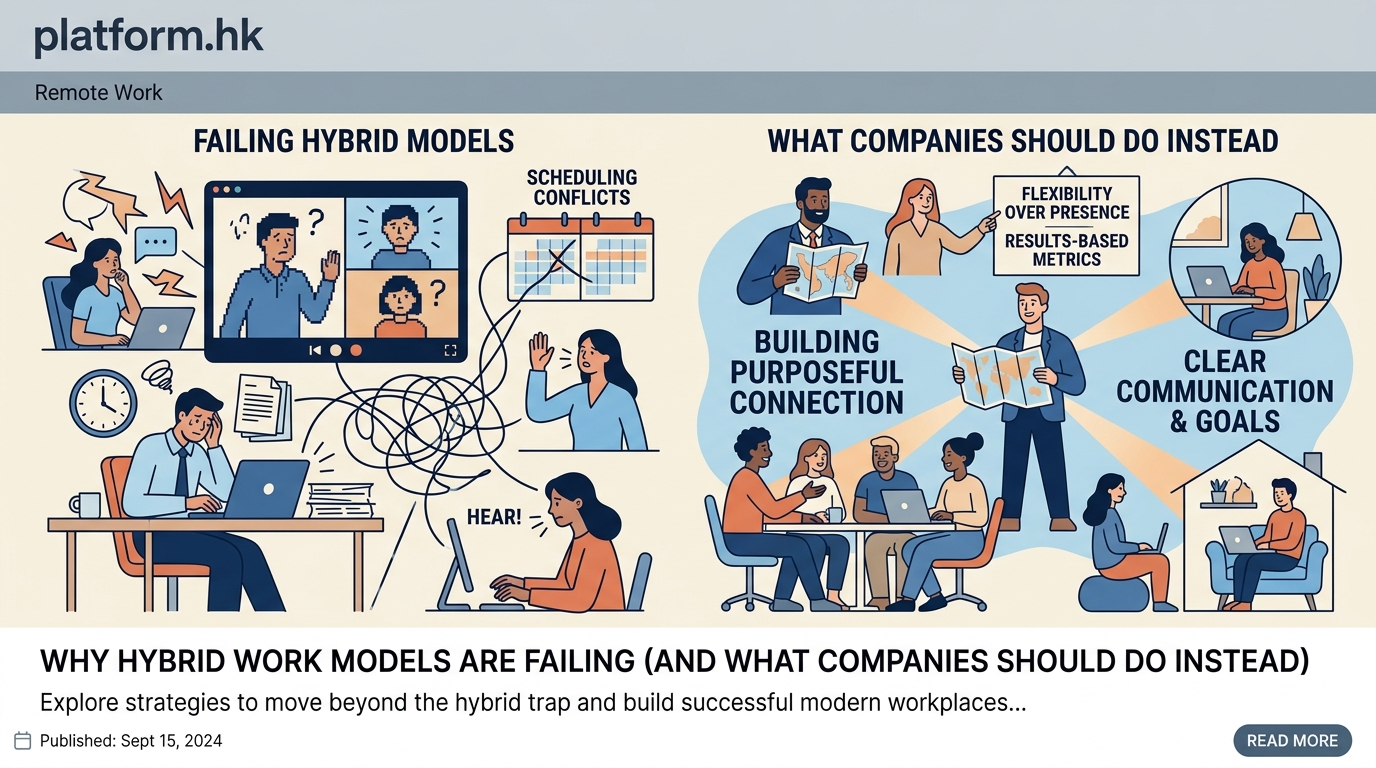
Why Hybrid Work Models Are Failing (And What Companies Should Do Instead)

Hybrid work was supposed to solve everything. Employees would get flexibility. Companies would save on real estate. Everyone would win.
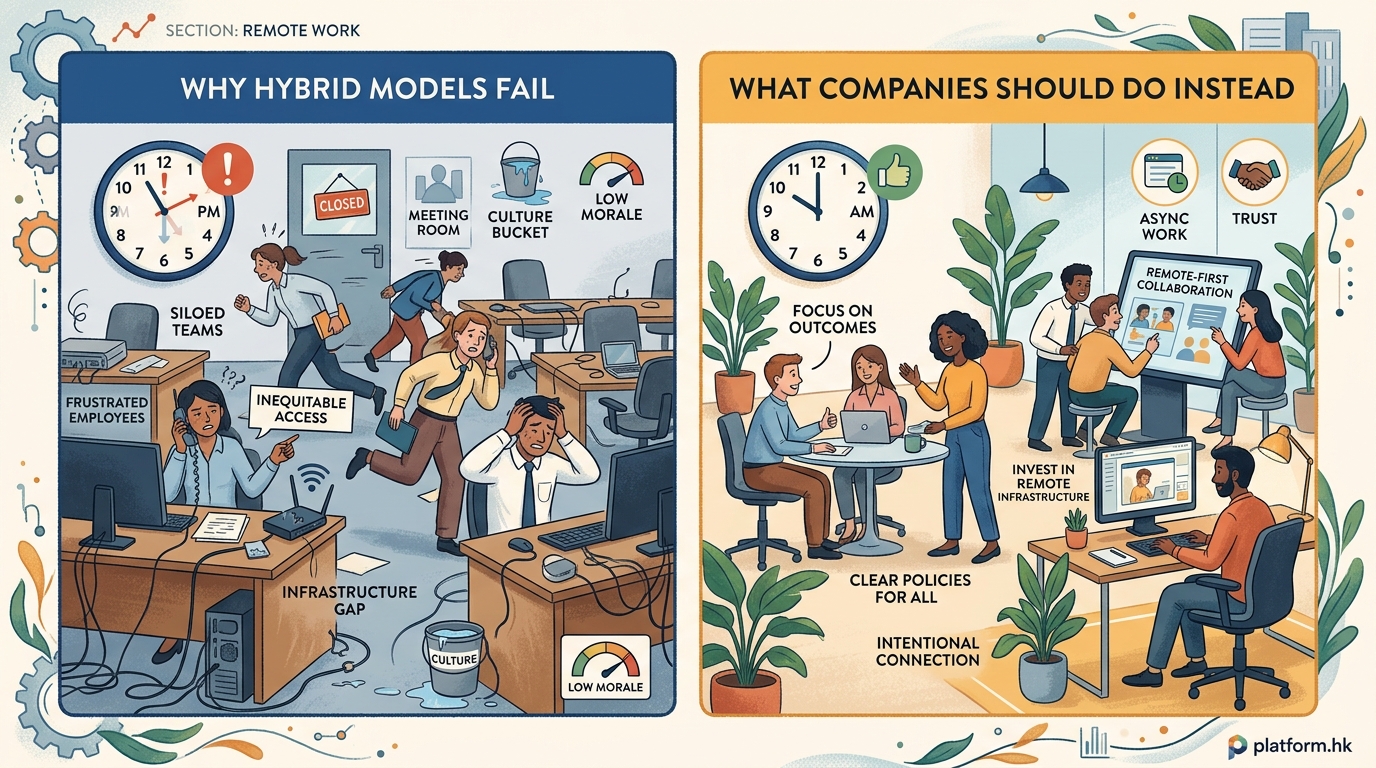
Instead, many organizations are stuck in a messy middle ground where nobody feels satisfied. Remote workers feel like second-class citizens. Office workers resent mandated days. Managers struggle to coordinate schedules. Productivity suffers, culture fractures, and leaders wonder where they went wrong.
Hybrid work models fail primarily due to poor communication, proximity bias, inconsistent policies, and inadequate technology. Companies that succeed make deliberate choices about when presence matters, invest in async collaboration tools, train managers to lead distributed teams, and create clear expectations. Half measures create two-tier cultures where nobody thrives. Commitment to intentional design beats compromise every time.
The proximity bias problem nobody talks about
Here’s what happens in most hybrid setups: managers default to favoring whoever shows up in the office.
It’s not always conscious. But the person who grabs coffee with the boss gets more visibility than the one joining via video. Impromptu hallway conversations turn into decisions that remote workers never hear about. Promotions skew toward people who are physically present.
Research consistently shows that remote workers receive fewer advancement opportunities, even when their performance matches or exceeds their in-office peers. The people working from home three days a week notice. They feel the difference.
This creates a two-tier system where your work location determines your career trajectory more than your actual contributions. Employees start gaming the system, showing up on days when leadership is present rather than when their work actually requires collaboration.
The fix requires intentional effort. If a meeting includes even one remote participant, everyone should join from their own screen. Document decisions in shared spaces, not side conversations. Evaluate performance based on output, not office attendance.
Communication breaks down across locations
Hybrid work multiplies communication channels without providing clear protocols for which to use when.
Should you send a Slack message or schedule a meeting? Is this urgent enough for synchronous discussion or can it wait for async response? Which decisions need the whole team present and which can happen in a shared document?
Without clear answers, teams default to overcommunicating through meetings or undercommunicating through scattered messages. Both create problems.
The meeting-heavy approach exhausts everyone and makes flexible schedules impossible. The async-only approach leaves people feeling disconnected and confused about priorities.
Here’s what actually works:
- Establish clear protocols for synchronous versus asynchronous communication
- Create decision logs that document what was decided, who decided it, and why
- Set core collaboration hours when everyone is available, but protect focus time outside those windows
- Use video for relationship building, async tools for information sharing
- Make all meetings optional by default with clear agendas and recorded outcomes
Companies that succeed treat communication design as seriously as product design. They don’t assume people will figure it out.
Nobody knows when they’re supposed to be where
The biggest complaint from employees in hybrid models? Confusion about expectations.
Some companies mandate specific days. Others leave it to team discretion. Many do both, creating contradictory policies where corporate says Tuesdays and Thursdays but your manager wants Mondays and Wednesdays.
Employees waste mental energy trying to optimize their schedules. Should I come in Tuesday because that’s policy or Thursday when my team has its planning session? What if I have a dentist appointment? Does that count as a remote day?
This constant calculation creates stress without adding value.
| Approach | Common Mistake | Better Alternative |
|---|---|---|
| Mandatory office days | Picking arbitrary days without considering team needs | Let teams choose their collaboration days based on actual work |
| Fully flexible | No coordination, empty offices, missed connections | Define anchor days for specific purposes (planning, reviews, social) |
| Individual choice | People optimize for commute, not collaboration | Create team agreements about when presence adds value |
| Manager discretion | Inconsistent policies across departments | Company-wide principles with team-level implementation |
The solution starts with answering one question: when does physical presence actually create value that virtual collaboration cannot?
For most knowledge work, the honest answer is less often than companies assume. But there are real moments where being together matters: onboarding new hires, brainstorming complex problems, building relationships across teams, celebrating wins.
Design your hybrid model around those specific moments rather than arbitrary day counts.
Technology becomes an afterthought
Companies invest millions in office space but treat collaboration technology like a checkbox item.
They buy video conferencing licenses and assume that’s enough. Then they wonder why hybrid meetings feel awkward, why remote workers seem disengaged, and why information gets lost.
The office was designed over decades to support in-person collaboration. Conference rooms, whiteboards, casual seating areas, all the small details that make working together feel natural.
Most companies haven’t made equivalent investments in their digital workspace. They’re trying to run a hybrid model with tools designed for either fully remote or fully in-office work.
Here’s what actually needs attention:
- Video setups that make remote participants feel present, not like faces in boxes
- Digital whiteboarding tools that actually work for real-time collaboration
- Async video tools for updates that don’t require everyone online simultaneously
- Project management systems that make work visible regardless of location
- Knowledge bases that capture decisions and context automatically
The technology budget should match the importance of making hybrid work actually work.
Managers weren’t trained for this
Most managers learned leadership in an office-first world. They managed by walking around, reading body language, having spontaneous check-ins.
Hybrid work requires different skills. You need to build trust without constant visibility. You need to coordinate across schedules and time zones. You need to ensure equity between remote and in-office team members.
Few companies invested in retraining their management layer for this reality.
The result? Managers default to what they know. They micromanage remote workers or ignore them completely. They schedule too many meetings to maintain control or too few and lose connection. They struggle to evaluate performance without physical presence as a proxy.
The transition to hybrid work isn’t just about where people work. It’s about fundamentally rethinking how we measure contribution, build culture, and develop talent. Companies that treat it as a real estate decision rather than a management transformation will continue struggling.
Training managers for hybrid leadership means teaching them to:
- Set clear outcomes rather than monitoring activity
- Run inclusive meetings where remote voices get equal airtime
- Build team connection through intentional practices, not accidental hallway chats
- Recognize and counteract their own proximity bias
- Use async communication effectively without losing urgency
This isn’t optional professional development. It’s core to making hybrid models function.
Culture suffers from half measures
Company culture used to happen organically through shared physical space. Lunch conversations, coffee breaks, after-work drinks, the accumulation of small interactions that build relationships.
Hybrid work disrupts all of that. But most companies haven’t replaced those organic moments with intentional alternatives.
They can’t. The office crew still has lunch together. The remote workers eat alone. Some people build relationships. Others feel isolated. Culture fragments along location lines.
The companies succeeding at hybrid culture do three things differently:
First, they create rituals that work regardless of location. Weekly team syncs where everyone shares wins and challenges. Monthly all-hands that celebrate achievements. Quarterly offsites that bring everyone together for strategic planning.
Second, they invest in relationship building as a legitimate work activity. Budget for virtual coffee chats. Create cross-functional projects that connect people who wouldn’t normally collaborate. Make space for non-work conversation.
Third, they measure belonging and connection as seriously as they measure revenue. Regular pulse surveys. Exit interview analysis. Tracking whether remote workers feel as connected as office workers.
Culture doesn’t happen by accident in hybrid models. It requires deliberate design and consistent effort.
The flexibility promise becomes a trap
Hybrid work was supposed to offer flexibility. Come to the office when it makes sense. Work from home when you need focus. Balance life and work on your terms.
Instead, many employees feel less flexible than before.
They can’t plan childcare because they don’t know their schedule two weeks out. They can’t take advantage of remote work benefits because they’re required in the office three days a week. They lose the structure of daily commutes without gaining real autonomy.
The worst of both worlds.
Real flexibility requires trust and clear boundaries. Trust that people will do their work without constant oversight. Boundaries that protect people from always-on expectations.
Most hybrid models fail on both counts. They add surveillance tools to monitor remote work. They schedule meetings across all time zones because “everyone’s flexible now.” They expect immediate responses regardless of when or where someone is working.
This isn’t flexibility. It’s chaos with a prettier name.
What companies should do instead
Fixing hybrid work starts with honest assessment. Is your model actually serving your goals or just splitting the difference between competing demands?
Here’s a framework for building something better:
Define your purpose. What are you trying to achieve with hybrid work? Cost savings? Talent access? Employee satisfaction? Different goals require different approaches. Be clear about what matters most.
Map value to presence. For each type of work your teams do, honestly assess whether physical presence adds value. Some activities genuinely benefit from being together. Many don’t. Design your hybrid model around the former.
Invest in infrastructure. Both physical and digital. Your office should be optimized for collaboration, not individual desk work. Your digital tools should enable seamless remote participation. Half measures on either create friction.
Train your leaders. Management in a hybrid world requires new skills. Provide real training, not just a webinar. Coach managers through the transition. Measure their effectiveness at creating inclusive, productive hybrid teams.
Create clear policies. People need to know what’s expected. When should they be in the office? What flexibility do they have? How will performance be evaluated? Ambiguity creates anxiety.
Measure what matters. Track employee sentiment across locations. Monitor whether remote workers advance at the same rate as office workers. Assess whether your hybrid model is achieving its stated goals. Adjust based on data, not assumptions.
Commit fully. The biggest mistake is treating hybrid as a temporary compromise. If you’re going hybrid, design for it intentionally. If you believe in-office work is essential, bring people back. The middle ground satisfies nobody.
Making hybrid work actually work
Hybrid work isn’t failing because the concept is flawed. It’s failing because most companies are implementing it poorly.
They’re applying office-first management to distributed teams. They’re creating policies based on real estate costs rather than work needs. They’re hoping technology and goodwill will bridge the gaps without investing in the infrastructure or training required.
The companies getting hybrid right treat it as a genuine transformation, not a scheduling adjustment. They redesign work processes, retrain managers, invest in tools, and measure outcomes ruthlessly.
They also recognize that hybrid isn’t the right answer for every company or every role. Sometimes fully remote makes more sense. Sometimes in-office is genuinely necessary. The key is making an intentional choice and committing to it fully.
Your hybrid model will keep failing until you stop treating it like a compromise and start treating it like a strategy. Define what success looks like. Build the systems to support it. Hold leaders accountable for making it work.
The future of work isn’t about where people sit. It’s about creating conditions where people can do their best work, build strong relationships, and grow their careers regardless of location. That future is possible, but it requires more than splitting the week between home and office.