7 Science-Backed Productivity Hacks Every Remote Worker Should Know

Working from home sounds perfect until you realize your couch is too comfortable, your fridge is too close, and your brain thinks 3 PM is nap time. Remote work gives you freedom, but it also removes the structure that kept you productive in an office. The good news? Science has figured out what actually works.
Remote workers can dramatically improve their productivity by understanding their natural energy rhythms, creating physical boundaries between work and life, taking strategic breaks, and using science-backed techniques like task batching and the Pomodoro method. These evidence-based strategies help you maintain focus, avoid burnout, and produce better work without sacrificing your mental health or personal time in a home office environment.
Work With Your Energy, Not Against It
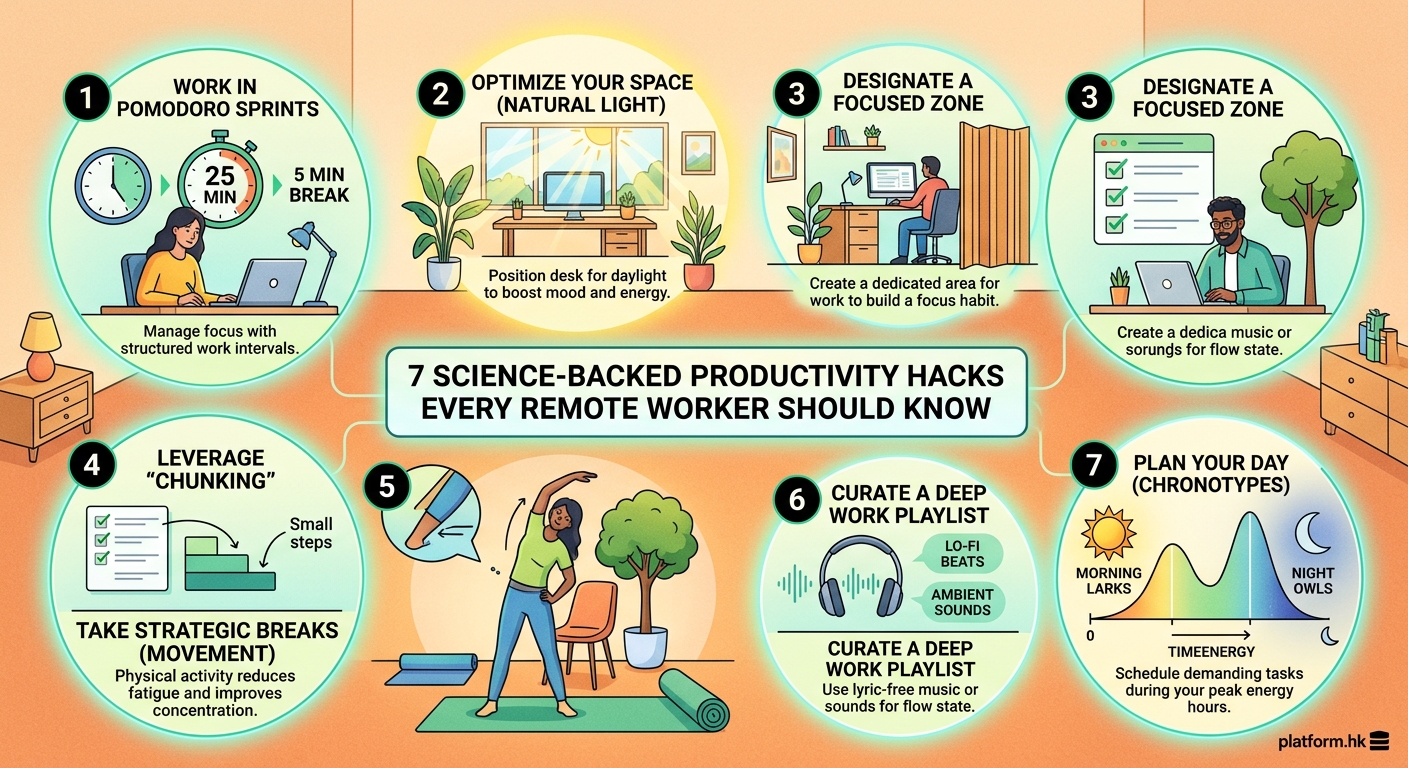
Your brain doesn’t run at the same speed all day. Research from chronobiology shows that most people experience peak cognitive performance during specific windows. For about 75% of adults, that window hits between 9 AM and 11 AM. Your prefrontal cortex is fresh, cortisol levels are optimal, and decision-making feels easier.
Here’s the mistake most remote workers make. They treat every hour the same. They answer emails at 10 AM when their brain could solve complex problems. Then they try to write a proposal at 4 PM when their glucose levels have tanked.
Track your energy for one week. Note when tasks feel effortless and when everything feels like wading through mud. Then build your schedule around those patterns, not arbitrary meeting times.
Schedule your hardest work during your peak hours. Save administrative tasks, email responses, and routine updates for your energy valleys. This simple shift can double your output without working more hours.
Create Physical Boundaries That Your Brain Recognizes
Your brain learns through association. When you work from your bed, your brain starts associating your bed with stress and deadlines. When you eat lunch at your desk, your brain never fully disengages from work mode.
A Stanford study found that remote workers who maintained a dedicated workspace reported 32% less work-related anxiety and better sleep quality. The boundary doesn’t need to be a separate room. It needs to be consistent.
Set up a specific spot that means work. It could be one corner of your dining table, a folding desk in your bedroom, or a chair that faces away from your TV. The location matters less than the consistency.
Add a physical ritual to mark the transition. Put on shoes you only wear for work. Light a specific candle. Play the same playlist. These cues tell your brain it’s time to focus.
When work ends, physically leave that space. Close your laptop, turn off your monitor, and move to a different room. Your evening self will thank your working self for maintaining that separation.
Use the Pomodoro Technique, But Make It Yours
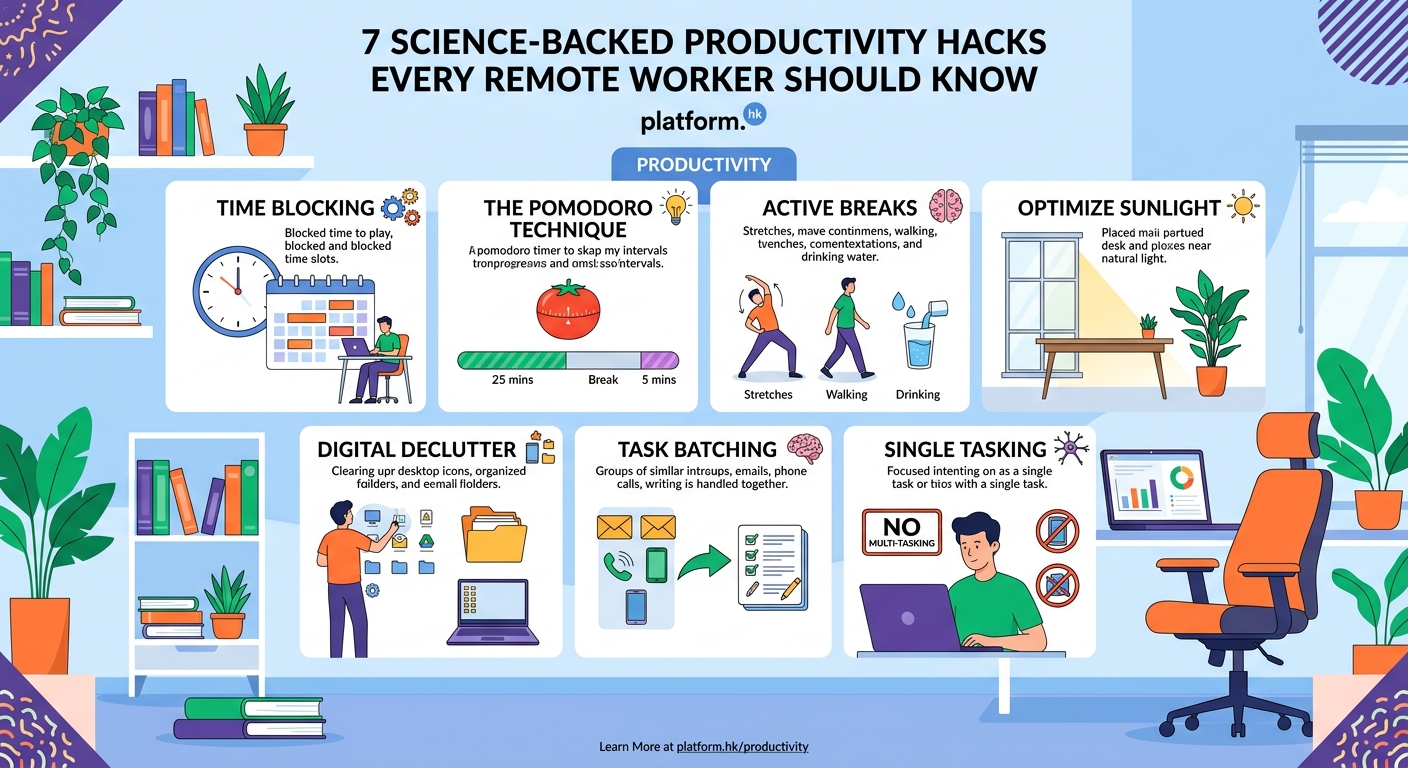
The Pomodoro Technique has been around since the 1980s, but neuroscience has confirmed why it works. Your brain’s prefrontal cortex can maintain intense focus for about 25 to 45 minutes before it needs a reset.
Here’s the basic structure:
- Choose one specific task
- Set a timer for 25 minutes
- Work without switching tasks or checking notifications
- Take a 5-minute break when the timer ends
- After four rounds, take a longer 15 to 30 minute break
The method works because it creates artificial urgency. When you know you only have 25 minutes, your brain stops procrastinating and starts producing. The breaks prevent mental fatigue before it tanks your performance.
Customize the timing to match your energy patterns. Some people focus better in 45-minute blocks. Others need 15-minute sprints. Test different intervals for a week and track which produces your best work.
During breaks, move away from your screen. Walk to another room. Do ten pushups. Make tea. Look out a window. The break only works if you actually disengage.
Batch Similar Tasks Together
Task switching destroys productivity. Research from the University of California found that it takes an average of 23 minutes to fully regain focus after switching tasks. If you check email five times per hour, you’re losing almost two hours of productive time.
Your brain uses different neural networks for different types of work. Writing uses different circuits than analyzing data. Creative brainstorming activates different regions than responding to messages. Every time you switch task types, your brain needs to power down one network and boot up another.
Group similar tasks into dedicated blocks. Handle all your email in two or three scheduled sessions instead of constantly monitoring your inbox. Batch all your calls on specific afternoons. Do all your content creation in one focused morning.
Here’s what a batched schedule might look like:
- 9:00 to 11:00: Deep work on your most important project
- 11:00 to 11:30: Email and Slack responses
- 11:30 to 12:30: Meetings and calls
- 12:30 to 1:30: Lunch and actual rest
- 1:30 to 3:00: Secondary projects or collaborative work
- 3:00 to 3:30: Administrative tasks and planning
- 3:30 to 5:00: Learning, reading, or lighter creative work
The specific times matter less than grouping similar cognitive demands together. Your brain will spend less energy switching gears and more energy doing actual work.
Move Your Body Every 90 Minutes
Sitting for extended periods doesn’t just hurt your back. It reduces blood flow to your brain, which directly impacts cognitive function. A study published in the Journal of Applied Physiology found that just two hours of uninterrupted sitting reduced blood flow to the brain by 20%.
Remote workers sit more than office workers because they skip the walk to the conference room, the trip to a colleague’s desk, and the commute itself. That extra sitting time adds up to measurable decreases in focus and problem-solving ability.
Set a timer for every 90 minutes. When it goes off, stand up and move for at least two minutes. The movement doesn’t need to be intense. Walk around your home. Do some stretches. Step outside for fresh air.
The 90-minute interval matches your ultradian rhythm, the natural cycle your body uses to regulate energy and attention throughout the day. Working with this rhythm instead of against it prevents the mid-afternoon crash that derails most remote workers.
If you want to level up, use movement breaks for specific cognitive benefits. Light cardio like walking or jogging increases blood flow and improves creative thinking. Stretching reduces physical tension that often manifests as mental stress. Strength exercises like pushups or squats provide a quick energy boost.
Build a Shutdown Ritual That Actually Works
The biggest hidden cost of remote work is the inability to stop working. When your office is your home, work never really ends. You check email after dinner. You think about projects while watching TV. Your brain never fully disengages.
Research from the American Psychological Association found that remote workers who lacked clear work boundaries reported 40% higher stress levels and significantly more sleep problems than those with structured shutdown routines.
Create a specific end-of-day ritual that signals to your brain that work is finished. This needs to be more substantial than just closing your laptop.
Here’s an effective shutdown sequence:
- Review what you accomplished today
- Write down your top three priorities for tomorrow
- Close all work-related apps and browser tabs
- Physically move your laptop out of sight
- Change your clothes or wash your hands
- Do one non-work activity that marks the transition
The ritual works because it creates closure. Your brain stops running background processes about unfinished work because you’ve explicitly acknowledged what’s done and what’s next.
Make the ritual non-negotiable. Do it even on days when you feel like you should keep working. Especially on those days. Consistent shutdown times protect your long-term productivity better than occasional late nights.
Manage Your Environment Like a Performance Space
Your physical environment directly impacts your cognitive performance. Studies in environmental psychology have identified specific factors that either enhance or degrade focus, creativity, and stamina.
Temperature matters more than most people realize. Research shows that cognitive performance peaks between 69 and 72 degrees Fahrenheit. Too cold and your body diverts energy to staying warm. Too hot and your brain slows down to prevent overheating.
Lighting affects both your circadian rhythm and your immediate alertness. Natural light is ideal, but if that’s not available, use bright white light during peak work hours. Dim, warm lighting signals to your brain that it’s time to wind down, which is terrible for afternoon productivity.
Sound environment varies by person and task. Some people focus better with complete silence. Others need background noise. White noise or ambient sounds can mask distracting household noises without pulling your attention the way music with lyrics does.
Here’s a comparison of common environment mistakes and their fixes:
| Common Mistake | Why It Hurts Productivity | Science-Backed Fix |
|---|---|---|
| Working in pajamas | Brain associates clothes with activity level | Wear real clothes, even casual ones |
| Dim lighting all day | Signals rest mode to your circadian system | Use bright light during work hours |
| Cluttered workspace | Visual noise increases cognitive load | Clear everything except current task items |
| Uncomfortable chair | Physical discomfort breaks focus every few minutes | Invest in proper seating or use cushions |
| Too quiet or too loud | Either extreme increases mental effort | Match sound level to task difficulty |
Make one environmental change per week. Track whether it improves your focus or energy. Keep the changes that work and drop the ones that don’t.
Protect Your Social Connection
Remote work eliminates casual social interaction. You don’t chat by the coffee maker. You don’t overhear interesting conversations. You don’t build relationships through repeated small encounters.
This isolation isn’t just lonely. It directly impacts your work quality. Research from MIT found that workers with regular social interaction produced more creative solutions and caught more errors in their own work. Social connection literally makes you smarter.
Schedule social time like you schedule meetings. Video calls with colleagues about non-work topics. Virtual coffee breaks. Coworking sessions where you work alongside others even if you’re not collaborating.
Join online communities related to your field or interests. Participate in discussions. Ask questions. Share what you’re learning. These interactions provide the professional connection that remote work removes.
Consider working from a coffee shop, library, or coworking space once or twice a week. The presence of other people, even strangers, can boost your motivation and focus. Researchers call this the “coffee shop effect,” and studies confirm it’s real.
“The absence of casual workplace interaction doesn’t just affect mood. It affects the quality of our thinking. Our brains evolved to solve problems in groups. When we work in complete isolation, we lose access to one of our most powerful cognitive tools.” — Dr. Susan Pinker, developmental psychologist
Build connection time into your schedule with the same priority you give to project deadlines. Your productivity depends on it.
Making These Habits Stick in Your Real Life
Knowing what works and actually doing it are different challenges. Most productivity advice fails because it ignores the messy reality of building new habits while managing existing responsibilities.
Start with one technique. Not seven. Pick the one that addresses your biggest current struggle. If you’re exhausted by 2 PM, start with energy management. If you can’t focus for more than ten minutes, try the Pomodoro method. If work bleeds into every evening, build a shutdown ritual first.
Practice that one technique for two full weeks before adding another. Research on habit formation shows that consistency matters more than perfection. Doing something imperfectly every day beats doing it perfectly twice.
Track your progress in the simplest way possible. A checkmark on a calendar. A note in your phone. A tally in a notebook. The tracking itself reinforces the behavior and helps you notice what’s actually working.
Expect resistance from your brain. New habits feel awkward and uncomfortable. That discomfort doesn’t mean the technique isn’t working. It means your brain is adapting to a new pattern. Push through the first week. It gets easier.
Adjust techniques to fit your life instead of forcing your life to fit the techniques. If 25-minute Pomodoros feel too short, try 40 minutes. If morning isn’t your peak time, schedule deep work for evening. The science provides the framework, but you customize the details.
Your Home Office Can Actually Work
Remote work isn’t going away. The flexibility is too valuable and the technology too good. But flexibility without structure leads to burnout, not balance.
These productivity hacks for remote workers aren’t about squeezing more hours out of your day. They’re about making the hours you work actually count. About finishing your day with energy left over. About producing better work without sacrificing your health or relationships.
Start tomorrow with one change. Track your energy. Set up a dedicated workspace. Try one Pomodoro session. Build a two-minute shutdown ritual. Pick one thing and do it.
Your most productive self isn’t hiding behind some perfect system. It’s waiting for you to work with your brain instead of against it.