How to Design Your Perfect Deep Work Schedule in a Coworking Space

Coworking spaces offer energy and community, but they can also be noisy, unpredictable, and full of distractions. If you want to do deep work in a shared environment, you need more than good intentions. You need a schedule that protects your focus while taking advantage of everything a coworking space offers.
A deep work schedule in a coworking space requires blocking your most focused hours, choosing the right zones, setting boundaries with others, and pairing shallow tasks with social time. This approach lets you maintain concentration while benefiting from the collaborative atmosphere that makes coworking spaces valuable for remote workers and freelancers.
Understanding deep work in shared environments
Deep work means sustained, distraction-free concentration on cognitively demanding tasks. Cal Newport defines it as professional activities performed in a state of focus that push your cognitive abilities to their limit.
Coworking spaces present a unique challenge. You’re surrounded by other people working on their own projects. Someone might take a phone call nearby. A group could be brainstorming at the next table. The coffee machine grinds beans every few minutes.
But these spaces also provide structure. You’re not at home where laundry and Netflix tempt you. You’re in a professional environment where others are working hard. That social pressure can actually help you stay on task.
The trick is designing a schedule that maximizes the benefits while minimizing the interruptions.
Mapping your energy to coworking space rhythms
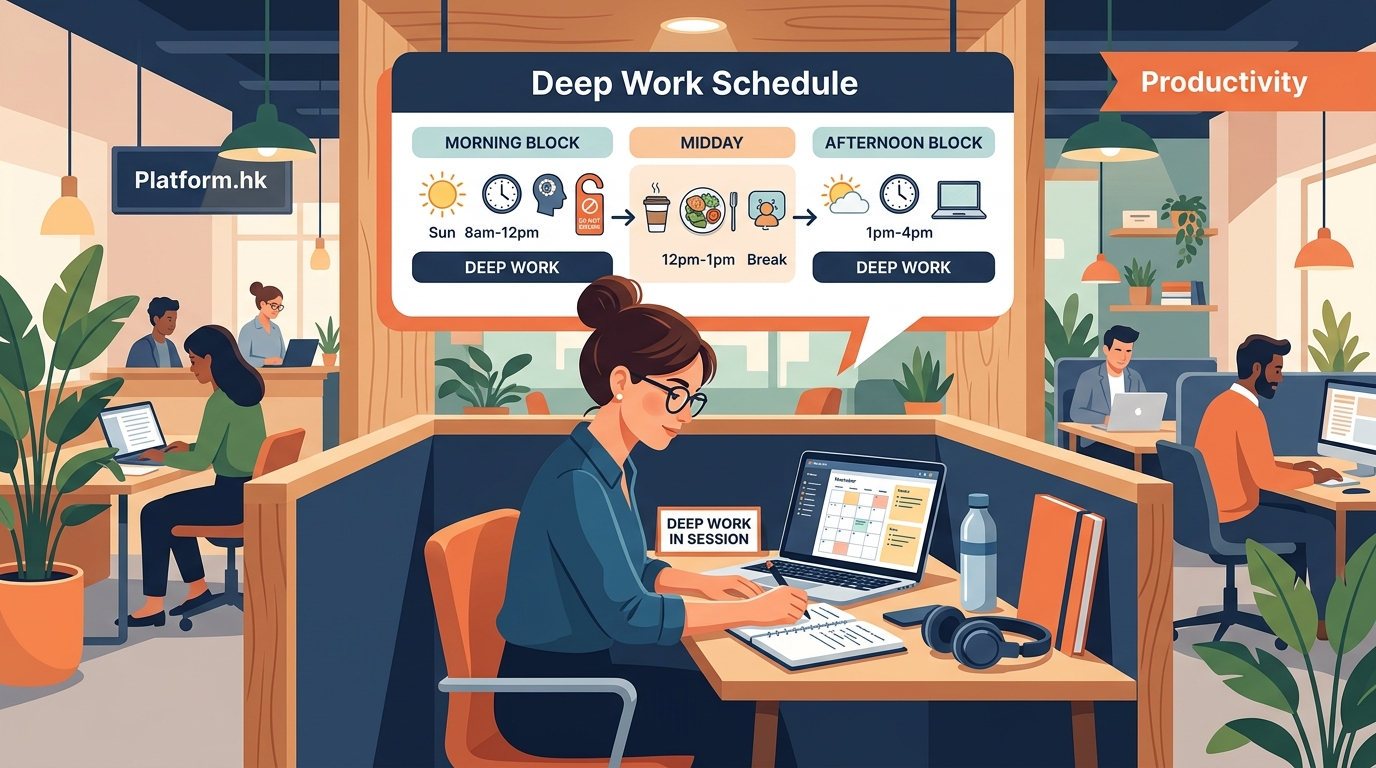
Most coworking spaces have natural rhythms. Mornings tend to be quieter. Lunch hours get social. Mid-afternoons see people coming and going. Late afternoons often settle down again.
Track the patterns at your specific space for a week. Note when it’s quietest, when people chat most, and when phone calls spike.
Then map your own energy patterns. When do you think most clearly? When does your focus start to fade? For most people, deep work capacity peaks in the morning and declines through the day.
Your ideal deep work schedule lives at the intersection of these two patterns. If you’re sharpest from 9 AM to noon and your coworking space is quietest then, that’s your golden window.
If your space gets noisy in the morning but you’re a morning person, you’ll need to adapt. Reserve a private room if available, or use noise-canceling headphones and white noise.
Building your deep work blocks
Start with these steps to create your actual schedule:
-
Identify your three most important deep work tasks for the week. These should require sustained concentration and move your most important projects forward.
-
Block 90-minute sessions on your calendar for these tasks. Research shows 90 minutes is about the maximum most people can maintain intense focus before needing a break.
-
Schedule these blocks during your peak energy hours and the space’s quietest times. Protect these blocks as fiercely as you would a client meeting.
-
Add a 15-minute buffer before each block to settle in, silence notifications, and get your materials ready.
-
Plan a real break after each session. Walk outside, get coffee, or chat with someone. Your brain needs recovery time.
-
Group shallow work (email, admin tasks, calls) into specific afternoon blocks when your focus naturally wanes and the space gets more social anyway.
The key is consistency. Your brain learns when to expect deep work. If you do focused sessions at the same time each day, you’ll drop into concentration faster.
Choosing the right zones for different work modes

Most coworking spaces have multiple zones. Learning which zone supports which type of work makes a huge difference.
-
Quiet zones or private rooms: Reserve these for your deepest work. Writing, coding, analysis, or strategic planning all belong here.
-
Open desks with moderate activity: Good for work that requires focus but tolerates some background noise. Design work, research, or editing often fit this category.
-
Communal tables and lounges: Perfect for shallow work, email, scheduling, or collaborative tasks where interruptions don’t hurt productivity.
-
Phone booths: Use these for calls so you don’t disrupt others and can speak freely.
-
Kitchen or cafe areas: Ideal for breaks, informal networking, and recharging between deep sessions.
Don’t try to do deep work in a social zone. The constant interruptions will fragment your attention. Move to where the environment matches your task.
Setting boundaries without seeming antisocial
Coworking spaces thrive on community. But community can conflict with deep work if you don’t set clear boundaries.
Here’s what works:
Wear headphones during deep work blocks. This signals you’re not available for chat. Most coworking members respect this signal.
Put a small sign on your desk during focus time. Something simple like “Deep work mode until 11:30” tells people when you’ll be available.
Be friendly and available during your shallow work blocks. If you’re approachable during designated times, people won’t feel rejected when you need to focus.
Explain your schedule to regular members. A simple “I do my focused work in the mornings, but I’m always up for coffee after 2 PM” helps people understand your patterns.
Join community events and lunches when they don’t conflict with your deep work blocks. This maintains relationships while protecting your productivity.
The goal is balance. You want the benefits of community without sacrificing the focus that makes you productive.
Handling common coworking distractions
Even with a good schedule, distractions happen. Here’s how to handle the most common ones:
| Distraction | Solution |
|---|---|
| Unexpected conversations | Politely say “I’m in the middle of something focused. Can we grab coffee at 2?” |
| Loud phone calls nearby | Move to a quieter zone or use noise-canceling headphones with brown noise |
| Events or workshops during your focus time | Check the community calendar weekly and adjust your schedule or work from home that day |
| Temptation to socialize | Schedule specific social time so you don’t feel like you’re missing out during deep work |
| Internet outages | Download necessary files before deep work sessions and have offline tasks ready as backup |
| Temperature or lighting issues | Arrive early to claim spots with good conditions, or bring a small desk lamp and layer clothing |
The most successful coworking members treat distractions as problems to solve, not reasons to give up on focus.
Syncing your schedule with team and client needs
If you work with clients or a remote team, your deep work schedule needs to accommodate their needs too.
Block your deep work hours first, then fit meetings around them. Most clients are fine with “I’m available for calls between 1 and 5 PM” if you’re responsive during those hours.
Use scheduling tools that show your availability. This prevents the back-and-forth of finding meeting times and protects your focus blocks automatically.
Batch your meetings on specific days if possible. Some people do “meeting Tuesdays and Thursdays” and keep Mondays, Wednesdays, and Fridays for deep work.
“The key to maintaining deep work as a freelancer is training clients to respect your schedule from the start. When you consistently deliver great work and respond promptly during your available hours, clients stop expecting instant replies and start trusting your process.” – Cal Newport, author of Deep Work
Communicate your working style early in client relationships. Most people respect boundaries when you set them clearly and professionally.
Adapting your schedule as projects change
Your deep work needs change as projects evolve. A week of client calls requires a different schedule than a week of heads-down development.
Review your schedule every Sunday evening. Look at the week ahead and identify which days need more deep work blocks versus collaborative time.
Adjust your coworking space usage accordingly. If you have a heavy focus week, consider coming in earlier when it’s quieter or booking private rooms in advance.
During lighter focus weeks, take advantage of networking opportunities and community events. These relationships often lead to future work.
Some remote workers alternate between deep work weeks and collaborative weeks. This rhythm lets them batch similar activities and reduce context switching.
Stay flexible. The best schedule is one you can actually maintain, not a perfect plan that falls apart when reality hits.
Measuring what actually works
Track your deep work hours for a month. Note when you scheduled focused time versus when you actually achieved flow state.
Pay attention to patterns. Maybe you scheduled morning deep work but kept getting interrupted. Or perhaps afternoon sessions worked better than expected.
Notice which tasks actually require deep work. Some things you think need intense focus might work fine with moderate concentration. Save your prime deep work blocks for tasks that truly demand them.
Measure output, not just hours. Two hours of genuine deep work often produces more than four hours of distracted effort.
Use this data to refine your schedule. If Tuesday mornings consistently produce your best work, protect that time ruthlessly. If Friday afternoons never work for focus, stop trying to force it.
Sample schedules for different work styles
The morning focused schedule:
- 8:00 AM: Arrive, settle in, review daily priorities
- 8:15 AM: Deep work block 1 (90 minutes)
- 9:45 AM: Break, walk, coffee
- 10:00 AM: Deep work block 2 (90 minutes)
- 11:30 AM: Shallow work (email, admin)
- 12:30 PM: Lunch, networking
- 1:30 PM: Meetings, calls, collaborative work
- 3:30 PM: Shallow work, planning for tomorrow
- 5:00 PM: Wrap up, leave
The split schedule:
- 9:00 AM: Arrive, shallow work, email
- 10:00 AM: Deep work block (90 minutes)
- 11:30 AM: Break
- 12:00 PM: Lunch, social time
- 1:00 PM: Meetings and calls
- 3:00 PM: Deep work block (90 minutes)
- 4:30 PM: Shallow work, wrap up
- 5:30 PM: Leave
The night owl schedule:
- 11:00 AM: Arrive, shallow work
- 12:00 PM: Lunch, networking
- 1:00 PM: Meetings, collaborative work
- 3:00 PM: Break
- 3:30 PM: Deep work block 1 (90 minutes)
- 5:00 PM: Break, dinner
- 6:00 PM: Deep work block 2 (90 minutes, when space empties out)
- 7:30 PM: Wrap up, leave
Pick a template that matches your energy patterns and your space’s rhythms. Modify it based on what you learn from tracking your actual performance.
Tools that support your deep work schedule
The right tools make your schedule easier to maintain.
Calendar blocking apps let you visually protect your deep work time. Color-code different work modes so you can see your week’s balance at a glance.
Focus timers help you stick to 90-minute blocks. The Pomodoro Technique works well for some people, though traditional 25-minute intervals might be too short for true deep work.
Noise apps provide consistent background sound that masks irregular office noise. Brown noise or ambient sounds work better than music with lyrics for most cognitive tasks.
Website blockers prevent you from reflexively checking social media or news during deep work. Freedom and Cold Turkey are popular options.
Task management systems help you identify which work actually needs deep focus. Not everything on your list requires intense concentration.
But don’t let tools become procrastination. The simplest effective system is better than a complex one you never use.
Making your schedule sustainable
A deep work schedule only helps if you can maintain it long-term.
Start with fewer deep work blocks than you think you can handle. Two solid 90-minute sessions per day beats four attempted sessions where you only achieve focus in one.
Build in flexibility. Life happens. Clients have emergencies. Some days you’ll need to adjust.
Protect your recovery time as much as your work time. Deep work is mentally exhausting. If you don’t rest properly, your capacity for focus will decline.
Take real weekends. The temptation to work seven days a week is strong when you’re freelancing, but it leads to burnout and declining work quality.
Notice when you’re forcing it. If you’ve been trying to focus for 20 minutes and keep getting distracted, take a break. Sometimes your brain needs rest more than it needs discipline.
Celebrate wins. When you complete a deep work session and make real progress, acknowledge it. This positive reinforcement makes it easier to stick with your schedule.
Your focus is a competitive advantage
Most remote workers never develop a consistent deep work practice. They respond to notifications all day, jump between tasks, and wonder why they feel busy but unproductive.
A well-designed deep work schedule in a coworking space gives you an edge. You get the focus of working alone with the energy and structure of working around others.
Start small. Block one 90-minute deep work session tomorrow during your sharpest hours. Notice how much you accomplish compared to a typical fragmented workday.
Then build from there. Add another block. Refine your schedule based on what works. Experiment with different zones in your space.
The coworking members who thrive aren’t necessarily the most talented. They’re the ones who protect their attention and design their days intentionally. Your schedule is your strategy. Make it count.