How to Find Investor-Ready Meeting Spaces When Your Startup Doesn’t Have an Office

Landing your first investor meeting feels like trying to get backstage at a sold-out concert. You know the opportunity exists, but the path to actually sitting across from someone who could fund your vision seems blocked by velvet ropes and gatekeepers.
Here’s the reality: most founders struggle not because their ideas lack merit, but because they approach investor outreach like cold calling strangers. The good news? Getting in front of investors follows predictable patterns once you understand how the system actually works.
Securing investor meetings requires building genuine relationships through warm introductions, demonstrating traction, and choosing professional meeting spaces that signal credibility. Focus on targeted outreach to investors who fund your stage and sector, prepare compelling materials that show momentum, and select venues that create the right impression when you lack a permanent office.
Why warm introductions beat cold emails every time
Investors receive hundreds of pitches monthly. Most get deleted within seconds.
The difference between a meeting and radio silence usually comes down to one factor: who made the introduction.
When someone an investor trusts vouches for you, your email moves from spam to priority. That trusted intermediary has essentially pre-screened you, saving the investor time and reducing their perceived risk.
Start by mapping your existing network. Look beyond obvious connections. That college roommate who now works at a tech company might golf with a partner at a venture fund. Your former manager could have gone to business school with an angel investor.
LinkedIn becomes your research tool here. Search for second-degree connections at target firms. See who you know in common. Then reach out to your mutual contact with a specific, respectful request.
Your message should be brief and clear about what you’re asking. Don’t ask your contact to invest. Ask if they’d be comfortable making an introduction if they think there’s a fit. Give them an easy out.
Provide a one-paragraph description of your company and why you think the investor would be interested. Make it simple for your contact to forward your note without extra work.
Building relationships before you need them
The best time to meet investors is before you’re fundraising.
This sounds counterintuitive, but investors prefer getting to know founders over time. When you eventually raise, you’re not a stranger asking for money. You’re someone they’ve watched build something real.
Attend industry events where investors speak. Ask thoughtful questions during Q&A sessions. Follow up with a genuine thank you email referencing something specific from their talk.
Share company updates quarterly, even when you’re not raising. Keep these brief. Highlight one or two meaningful metrics or milestones. Show progress without asking for anything.
Some founders create informal advisor relationships with investors. You get guidance. They get early visibility into what you’re building. When you’re ready to raise, they’ve already done months of due diligence.
Join startup communities and accelerators where investors hang out. Y Combinator, Techstars, and similar programs provide built-in investor access. Even local startup groups host pitch nights and office hours with active investors.
The goal isn’t to pitch everyone you meet. It’s to become a known entity in the ecosystem so when you do raise, people have context for who you are.
Finding the right investors for your stage and sector
Not all money is equal, and not all investors are right for your company.
Seed-stage companies shouldn’t pitch growth-stage funds. B2B software startups waste time approaching consumer-focused investors. Geographic focus matters too. Some funds only invest locally.
Research before you reach out. Most venture firms publish investment criteria on their websites. They list check sizes, preferred stages, and sector focus. Read their portfolio. If they’ve never funded a company like yours, they probably won’t start now.
Angel investors offer more flexibility but require different research. AngelList, Crunchbase, and LinkedIn help identify individuals who invest in your space. Look at who funded companies similar to yours.
Create a tiered target list:
- Tier 1: Perfect fit investors with warm intro paths
- Tier 2: Good fit investors where you need to build connections
- Tier 3: Possible fit investors for future consideration
Focus your energy on Tier 1. These represent your highest probability meetings. Work systematically through warm introduction paths before resorting to cold outreach.
Track every interaction in a simple spreadsheet. Note who introduced you, when you last connected, and next steps. Fundraising is a pipeline like sales. Treat it accordingly.
Preparing materials that open doors

Your initial outreach needs to accomplish one thing: get a meeting.
Most founders make materials too long or too vague. Investors decide whether to meet you based on minimal information. Give them just enough to say yes.
A strong cold email (when warm intros aren’t possible) follows this structure:
- One sentence on what your company does
- One sentence on traction or validation
- One sentence on why you’re reaching out to them specifically
- Clear ask for a 20-minute call
Skip the life story. Investors who want more details will ask.
Your deck serves a different purpose. It supports the conversation during your meeting, not before. Keep it to 10-12 slides covering problem, solution, market size, business model, traction, team, and ask.
Traction matters more than anything else in your materials. Revenue, user growth, partnerships, press coverage. Show momentum. Investors back companies that are already moving.
If you’re pre-traction, focus on team credentials and unique insights. Why are you the right people to solve this problem? What do you know that others don’t?
Choosing meeting spaces that signal professionalism
You’ve landed the meeting. Now you need somewhere to hold it.
Meeting at a coffee shop works for casual conversations. Investor pitches require something more polished. The environment you choose sends signals about how you operate.
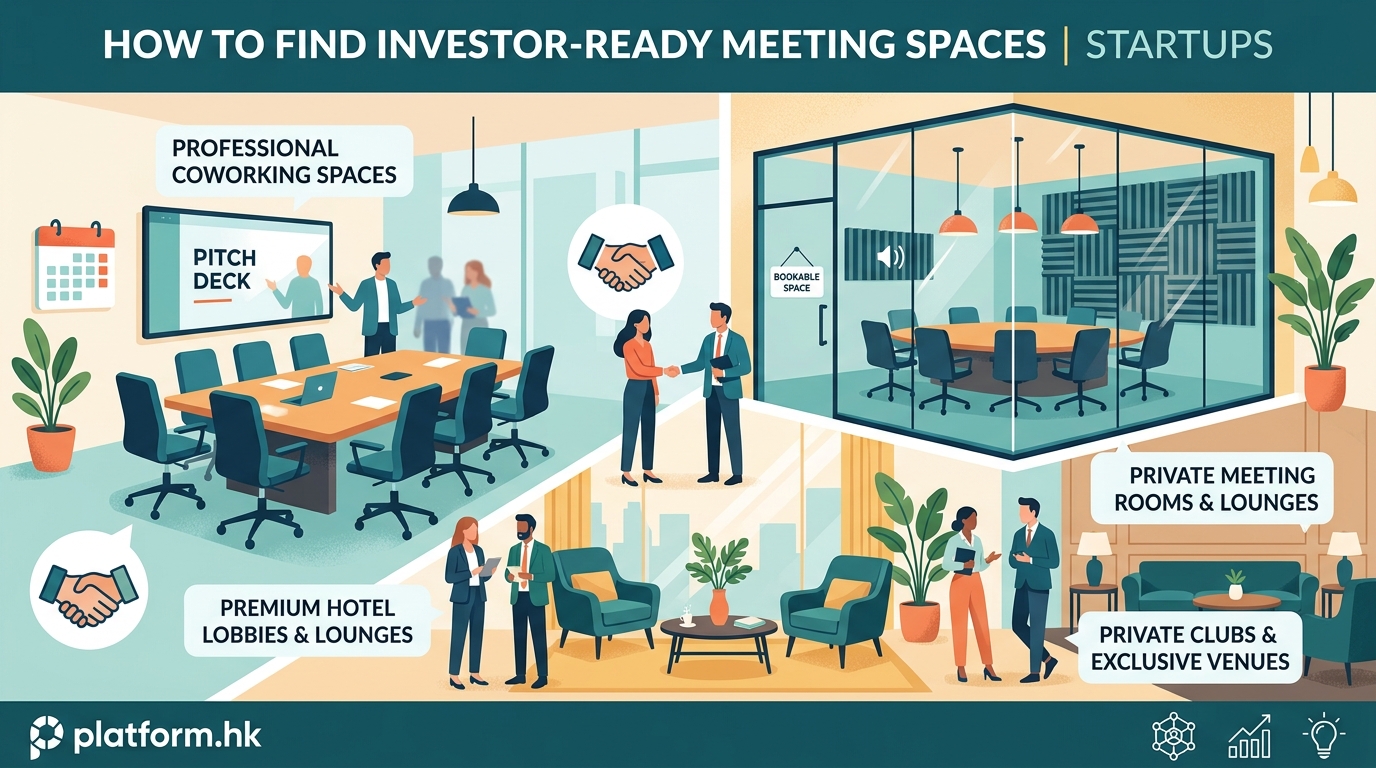
Professional meeting rooms solve this problem without requiring a permanent office. Coworking spaces, business centers, and hotel meeting rooms offer hourly bookings designed exactly for this scenario.
Look for spaces with these features:
- Reliable WiFi for screen sharing presentations
- Professional furniture and lighting
- Privacy from ambient noise and interruptions
- Easy access via public transit or parking
- Conference call capability if remote participants join
Book spaces in business districts when possible. Meeting in a recognized professional building adds credibility. It suggests you’re serious and established, even if you’re working from home between meetings.
Test technology before your investor arrives. Connect your laptop to the screen. Check audio levels. Have backup plans for technical failures. Nothing undermines confidence like fumbling with HDMI cables while your investor waits.
Some cities offer startup-specific resources. Incubators and accelerators sometimes allow member companies to book meeting rooms. Local economic development offices occasionally provide free or subsidized professional spaces for emerging businesses.
Timing your outreach for maximum response
When you send your message matters almost as much as what you say.
Avoid Mondays when inboxes overflow from the weekend. Skip Fridays when people mentally check out. Tuesday through Thursday mornings typically see the highest response rates.
Don’t reach out during major holiday weeks or in August when many investors vacation. December gets tricky too as funds close out their year.
Industry conference weeks can work both ways. Investors are busy but also in deal mode, meeting lots of companies. If you’re attending the same event, suggesting a coffee between sessions can work well.
Follow up strategically. If you don’t hear back after five business days, send a brief, friendly follow-up. Reference your original message and offer to send additional information. One follow-up is professional. Three becomes annoying.
Some investors simply won’t respond. Their silence is an answer. Move on to the next name on your list rather than burning energy on people who’ve shown disinterest.
Common mistakes that kill meeting opportunities
Certain behaviors guarantee you won’t get a meeting, no matter how good your company is.
Mass CC’ing multiple investors on the same email shows you’re spray-and-pray pitching. Investors talk to each other. They notice when you’re not selective.
Asking for NDAs before sharing basic information signals you don’t understand how venture capital works. Ideas aren’t protectable. Execution is what matters. Investors won’t sign NDAs for initial conversations.
Being vague about what you’re building in hopes of generating curiosity usually just generates confusion. Investors need enough specifics to assess fit. Mystery doesn’t create intrigue in fundraising.
Pitching over email instead of asking for a meeting rarely works. Your goal is conversation, not closing a deal via written correspondence. Get the meeting, then make your case.
Failing to research the investor wastes everyone’s time. If their fund explicitly states they don’t invest in your category or stage, don’t reach out hoping you’re the exception.
| Strategy | Why It Works | Common Mistake to Avoid |
|---|---|---|
| Warm introductions | Leverages existing trust and credibility | Asking for intros from weak connections who barely know you |
| Sector-specific targeting | Shows you understand investor focus areas | Pitching every investor regardless of their portfolio |
| Traction-focused materials | Demonstrates real market validation | Leading with vision instead of proof points |
| Professional meeting spaces | Signals operational maturity | Choosing venues based only on price |
| Strategic follow-up | Keeps you visible without being pushy | Following up too frequently or aggressively |
What to do when you’re getting consistent rejections
Hearing “no” repeatedly means something needs adjustment.
First, check if you’re targeting the right stage. Pre-revenue companies pitching Series A funds will get rejected regardless of quality. Make sure your ask matches investor mandates.
Second, examine your traction story. If you lack meaningful metrics, consider building more before fundraising. Sometimes the right move is spending another quarter proving your model works.
Third, get feedback. When investors pass, ask what would need to change for them to reconsider. Most won’t respond, but some will offer genuine insights. Look for patterns in the feedback you do receive.
Fourth, audit your materials. Show your deck to founders who’ve successfully raised. Ask them to be brutally honest. Unclear positioning or weak storytelling can sink otherwise solid companies.
Finally, consider if you need a different approach entirely. Some businesses bootstrap better than they fundraise. Revenue-based financing, grants, or competitions might provide capital without traditional venture backing.
“The founders who succeed at fundraising aren’t always the ones with the best ideas. They’re the ones who understand that getting investor meetings is itself a skill that can be learned and improved through iteration.” – Seasoned startup advisor
Making the most of meetings once you get them
You’ve secured the meeting. Now execution matters.
Arrive early to settle in and test equipment. Being flustered and late creates the wrong first impression.
Start with conversation, not slides. Ask the investor what they’d most like to understand about your company. Let their questions guide the discussion rather than marching through a predetermined script.
Tell a story, not a feature list. Explain the problem you encountered, how you discovered it mattered to others, and what you built to solve it. People remember narratives better than bullet points.
Be honest about challenges and risks. Investors expect problems. Pretending everything is perfect makes you seem naive. Showing you understand obstacles and have plans to address them builds credibility.
Watch the clock. If you scheduled 30 minutes, wrap up in 25. Respecting their time increases chances they’ll meet again.
End with clear next steps. Don’t leave the meeting ambiguous. Ask what additional information they need and when you should follow up.
Send a thank you email within 24 hours. Reference something specific from your conversation. Attach any materials you promised. Confirm the timeline you discussed.
Why your meeting location matters more than you think
The space where you meet investors influences their perception of your company.
Meeting in a generic coffee shop surrounded by students on laptops doesn’t scream “serious business opportunity.” Neither does a cluttered coworking hot desk with people eating lunch behind you.
Professional meeting rooms create an environment focused entirely on your conversation. No distractions. No ambient noise. Just you, the investor, and your presentation.
The location also needs to respect the investor’s time. Choose spaces convenient to their office. Don’t ask them to travel across the city unless you have a compelling reason.
Some founders worry that booking meeting space seems like an unnecessary expense for an early-stage company. The opposite is true. It shows you understand presentation matters and you’re willing to invest in making a professional impression.
Think of the meeting room cost as marketing spend. You’re paying to create the optimal environment for a conversation that could result in hundreds of thousands or millions in funding.
Many business centers and coworking spaces offer day passes or meeting room hourly rates starting around $25-50. That’s a small price for the right setting.
Turning initial meetings into ongoing relationships
Your first investor meeting rarely results in immediate funding.
Most investors want to see you again before writing a check. They’re evaluating not just your current state but your trajectory. Can you execute on what you promised? Do metrics improve between meetings?
Schedule regular updates even after an initial pass. Share monthly or quarterly progress reports. When you hit milestones, let them know. When you face setbacks, share how you’re adapting.
Some investors will offer to help even before investing. Take them up on it. Ask for introductions to potential customers, advisors, or other investors. Let them add value to your company before they add capital.
Build a group of investors who know your company well. When you formally raise, these relationships convert faster than cold prospects. You’ve already done months of relationship building.
Think of investor meetings as the start of years-long relationships, not one-time pitches. The partner who passes on your seed round might lead your Series A. The associate you meet today could be a partner at a different fund tomorrow.
Your next steps start now
Getting investor meetings comes down to intentional relationship building, targeted outreach, and professional presentation.
Start by mapping your network for warm introduction paths. Identify investors who actually fund companies at your stage in your sector. Prepare concise materials that highlight traction and team. Choose meeting venues that create the right environment for serious business discussions.
Remember that fundraising is a process, not an event. Each conversation builds toward the next. Each rejection teaches you something about your positioning or timing. Each connection expands your network for future rounds.
The founders who successfully raise capital treat investor outreach like a systematic campaign. They track conversations, follow up consistently, and improve their approach based on feedback.
You don’t need a fancy office to meet with investors. You just need a professional space for an hour and a compelling story about what you’re building. The rest comes down to preparation, persistence, and showing up ready to have a real conversation about your business.
Book that meeting room. Send those introduction requests. Refine your pitch. Your next investor meeting is closer than you think.