Calculating the Real Cost: Coworking vs. Office Lease for Early-Stage Startups

Choosing between coworking and a traditional office lease isn’t just about monthly rent. For early-stage startups, this decision can mean the difference between runway that lasts six months or eighteen. The sticker price rarely tells the full story.
Coworking spaces typically cost less upfront but more per desk long-term, while office leases demand significant capital but offer lower per-person rates at scale. Hidden costs like furniture, internet, cleaning, and security deposits can double your actual workspace expenses. Your best choice depends on team size, growth trajectory, and how much cash you can tie up in deposits and equipment.
Breaking down the real numbers behind workspace costs
Most founders start their cost comparison by looking at monthly rates. That’s a mistake.
A coworking membership might advertise $350 per desk per month. A small office lease might show $2,800 monthly for 800 square feet. At first glance, the coworking space looks cheaper for teams under eight people. But those numbers hide half the equation.
Office leases come with security deposits, often three to six months of rent. That same $2,800 monthly lease could require $8,400 to $16,800 upfront before you get keys. Then you need furniture, which runs $800 to $2,000 per workstation for decent quality. Internet installation costs $500 to $1,500, with monthly fees around $200 to $400 for business-grade service.
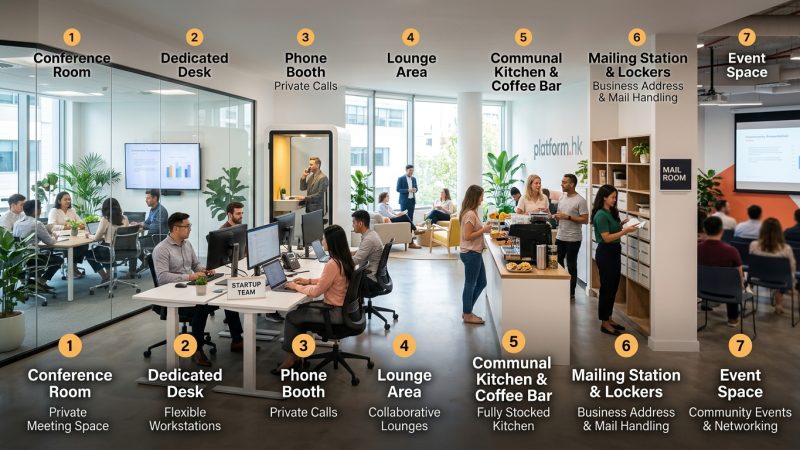
Coworking spaces bundle everything into that monthly rate. No furniture purchases. No utility setup. No cleaning contracts. You show up, sit down, and start working.
But here’s where it gets interesting. That convenience premium adds up fast as your team grows.
The hidden costs that catch founders off guard
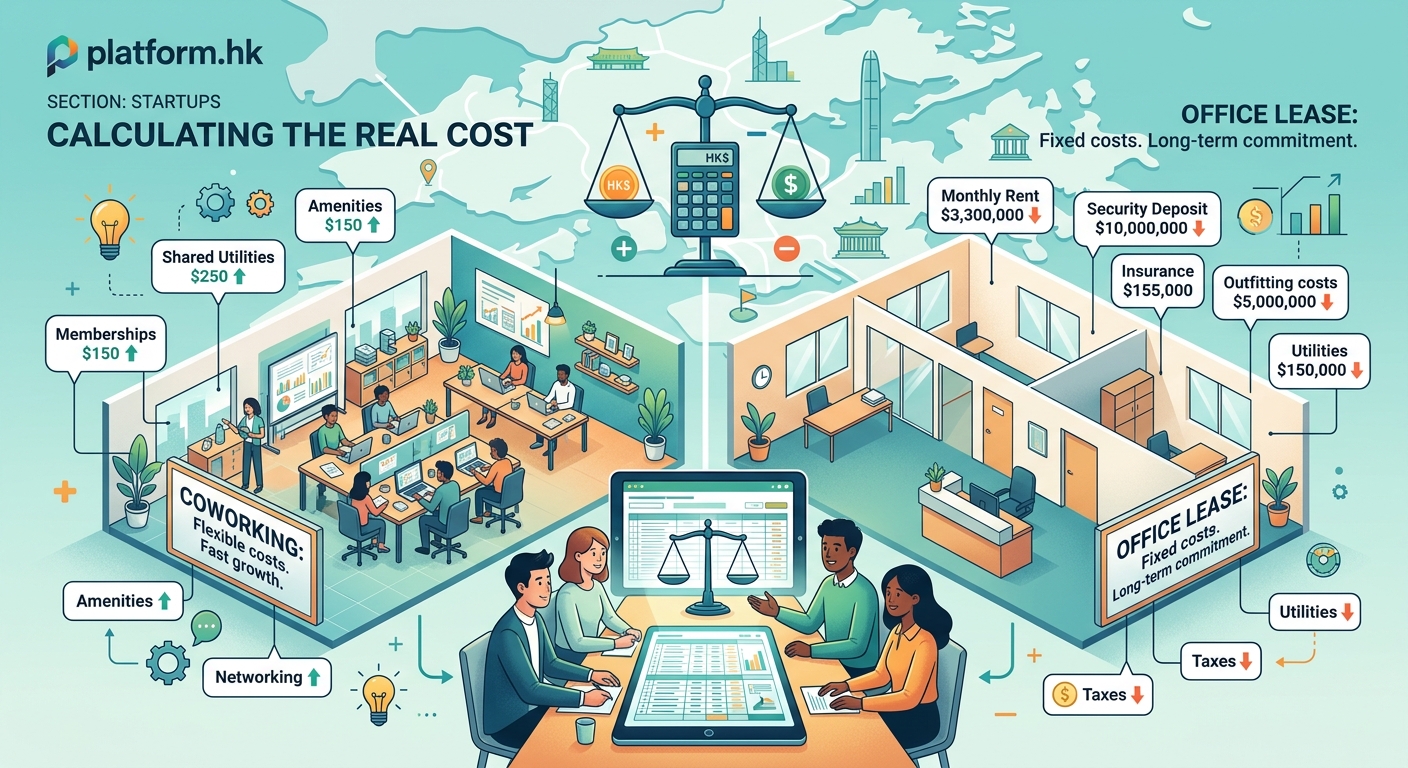
Every workspace option carries expenses that don’t appear in the initial quote. Understanding these costs prevents budget surprises three months after you sign.
Traditional office lease hidden costs:
- Building maintenance fees, typically 10-15% of base rent
- Utilities averaging $2 to $4 per square foot annually
- Cleaning services at $100 to $300 monthly for small spaces
- Coffee, kitchen supplies, and toilet paper (yes, really)
- Property insurance requirements
- Parking fees or validation systems
- Security system installation and monitoring
- HVAC repairs and maintenance
- Light bulb replacements and minor repairs
- Pest control services
Coworking space hidden costs:
- Printing and copying fees beyond basic allowances
- Meeting room bookings for longer sessions
- Dedicated phone booth reservations
- Mail handling and package receiving charges
- Guest passes for clients or contractors
- Parking validation or monthly parking fees
- Premium location surcharges
- Upgrade fees for larger desks or private areas
- Storage locker rentals for equipment
- After-hours access fees at some locations
The maintenance fees on office leases deserve special attention. Landlords charge these fees to cover building upkeep, but they’re rarely negotiable and can increase annually without warning.
Calculating your true monthly workspace expense
Let’s run real numbers for a five-person startup in a mid-sized city. This comparison uses actual market rates from 2025.
Coworking option:
- Five dedicated desks at $375 each: $1,875
- One small meeting room (10 hours monthly): $150
- Printing allowance overages: $25
- Parking for two team members: $200
- Monthly total: $2,250
Office lease option:
- Base rent for 600 sq ft at $28 per sq ft annually: $1,400 monthly
- Maintenance fees at 12% of rent: $168
- Utilities (electric, water, internet): $350
- Cleaning service twice weekly: $200
- Furniture amortized over 36 months: $278
- Coffee and kitchen supplies: $75
- Insurance: $85
- Monthly total: $2,556
The coworking space costs less monthly. But we haven’t factored in the upfront costs yet.
Office lease upfront costs:
- Security deposit (3 months): $4,200
- First month’s rent: $1,400
- Furniture purchase: $10,000
- Internet installation: $800
- Minor renovations and paint: $1,500
- Total upfront: $17,900
Coworking upfront costs:
- First month: $2,250
- Security deposit (usually one month): $2,250
- Total upfront: $4,500
The office lease requires $13,400 more in initial capital. For a bootstrapped startup, that’s a significant difference.
When team size changes the math completely
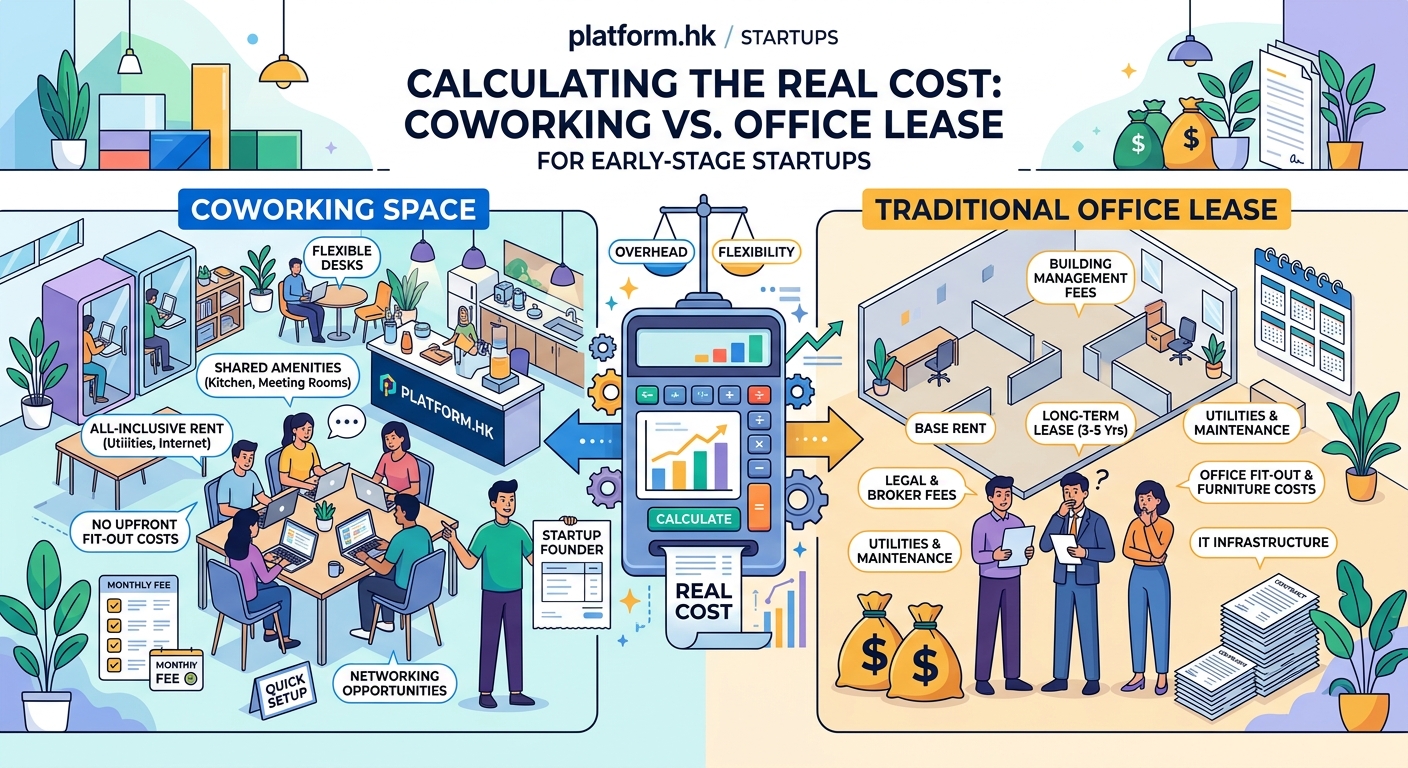
The crossover point where office leases become cheaper happens around 10 to 15 people, depending on your market.
Here’s a comparison table showing cost per person at different team sizes:
| Team Size | Coworking Monthly | Office Lease Monthly | Cost Difference |
|---|---|---|---|
| 3 people | $1,125 | $2,556 | Coworking saves $1,431 |
| 5 people | $2,250 | $2,556 | Coworking saves $306 |
| 8 people | $3,000 | $3,200 | Coworking saves $200 |
| 12 people | $4,500 | $4,100 | Office saves $400 |
| 20 people | $7,500 | $5,800 | Office saves $1,700 |
These numbers assume you’re comparing similar quality spaces. A premium coworking space in a downtown high-rise will cost more than a basic office in a suburban business park.
The calculation shifts if you expect rapid growth. Signing a two-year lease for five people when you plan to hire 15 more in six months creates problems. You’ll either need to break the lease early (expensive) or cram too many people into too little space (miserable).
Coworking spaces let you add desks monthly. Most require just 30 days notice to scale up or down.
Flexibility costs money, but inflexibility costs more
Traditional leases lock you in for one to five years. Breaking a lease early typically means paying the remaining months in full, minus whatever the landlord can recover by re-leasing the space. That penalty can easily reach $50,000 or more for a mid-sized office.
Coworking agreements usually run month-to-month or require three to twelve-month commitments. The shorter the commitment, the higher the monthly rate. But even a twelve-month coworking contract beats a three-year office lease for flexibility.
“We signed a three-year lease thinking we’d grow into the space. Then our funding round fell through. We spent eight months paying for an office we couldn’t afford while desperately trying to sublet it. That lease nearly killed the company.” – Founder of a B2B SaaS startup
Subletting sounds like a solution, but most commercial leases require landlord approval. Landlords often refuse or demand fees. Even when they approve, you’re still legally responsible if your subtenant damages the property or stops paying rent.
The flexibility premium in coworking spaces acts like insurance. You pay extra monthly to avoid catastrophic costs if circumstances change.
The amenities calculation nobody does correctly
Coworking spaces advertise impressive amenities: coffee bars, beer on tap, yoga studios, podcast rooms, rooftop terraces. These perks sound great in tours but matter less than you’d think for daily work.
What actually matters:
- Reliable, fast internet (minimum 100 Mbps per person)
- Enough meeting rooms that you can book one when needed
- Reasonable noise levels during calls
- Comfortable chairs that don’t wreck your back
- Climate control that works
- Bathrooms that stay clean and stocked
The fancy stuff is nice but doesn’t justify a $100 per desk monthly premium.
Office leases give you complete control over amenities. You choose the coffee machine, the furniture brand, the artwork. But you also handle every problem. When the internet goes down, you call the provider and wait. When the toilet clogs, you call a plumber. When the HVAC fails in August, you’re sweating until the repair person arrives.
Coworking spaces handle all maintenance and problems. That convenience has real value, especially for small teams without an office manager.
Location premiums and commute trade-offs
Coworking spaces cluster in premium locations because their business model requires high visibility and foot traffic. You’ll find them in downtown cores, trendy neighborhoods, and transit-adjacent buildings.
Office leases span the full range from Class A downtown towers to converted warehouses in industrial areas. The location flexibility lets you optimize for cost, commute times, or proximity to customers.
A downtown coworking space might cost $450 per desk while an office lease in the same building runs $40 per square foot annually (about $400 per desk monthly including all costs). But that same office lease drops to $20 per square foot in a suburb 20 minutes away.
The commute matters more than founders realize. A team that spends an extra 30 minutes each way commuting to a cheaper office loses 5 hours per person weekly. For a five-person team, that’s 25 hours of productivity gone. At $50 per hour average fully-loaded cost, you’re losing $1,250 weekly in productivity to save maybe $500 monthly in rent.
Location also affects recruiting. Talented people care about commute times and neighborhood quality. An office in a boring business park makes hiring harder.
The tax implications that shift the calculation
Both coworking and office leases qualify as tax-deductible business expenses. But the accounting treatment differs slightly.
Office lease security deposits aren’t immediately deductible. You deduct them when you get the money back or when the landlord applies them to damages. That three-month security deposit ties up capital without providing a tax benefit.
Furniture and equipment purchases must be depreciated over several years, though Section 179 deductions let you write off up to $1,160,000 in qualifying property immediately (as of 2025). Most startups benefit more from immediate deductions than depreciation schedules.
Coworking expenses are fully deductible in the month you pay them. The accounting is simpler, which saves bookkeeping time and reduces accounting fees.
These tax differences rarely change the fundamental economics, but they’re worth discussing with your accountant.
Common mistakes that waste thousands
Founders make predictable errors when comparing workspace costs. Avoiding these mistakes saves money and headaches.
Mistake 1: Ignoring growth scenarios
You need space for your current team plus reasonable growth. Signing a lease that fits exactly five people means you’ll need to move or sublease within months if you hire successfully.
Mistake 2: Underestimating setup time
Office leases can take 30 to 90 days from signing to move-in once you factor in furniture delivery, internet installation, and minor improvements. Coworking spaces are ready immediately. If you need space fast, that timeline difference matters.
Mistake 3: Forgetting about furniture resale value
Quality office furniture retains 20% to 40% of its value. When you eventually move or close, you can recover some costs. Budget furniture has essentially zero resale value.
Mistake 4: Comparing different quality tiers
A premium coworking space with standing desks and Herman Miller chairs shouldn’t be compared to a bare-bones office with IKEA furniture. Match quality levels for fair comparisons.
Mistake 5: Ignoring contract exit clauses
Read the termination terms carefully. Some coworking spaces require 60 or 90 days notice. Some office leases have early termination options if you pay a penalty equal to three to six months rent.
The psychological costs of each option
Numbers don’t capture everything. The workspace environment affects team morale, productivity, and culture in ways that don’t show up on spreadsheets.
Coworking spaces create energy through density. You’re surrounded by other startups, freelancers, and small businesses. That environment can be inspiring or distracting depending on your personality and work style. Some people thrive on the ambient energy. Others find it exhausting.
Private offices offer control and quiet. Your team can talk freely without worrying about neighbors overhearing customer calls or strategic discussions. You can decorate however you want, play music, and establish your own culture.
But private offices can feel isolating, especially for small teams. The four walls get boring. You miss the serendipitous conversations and networking that happen naturally in coworking spaces.
Consider your team’s personalities and work requirements. Engineers doing deep focus work might prefer quiet private offices. Sales teams making calls all day need sound-controlled spaces. Creative teams might thrive in the dynamic coworking environment.
Making the decision with incomplete information
You won’t have perfect data when choosing a workspace. Growth projections are guesses. Market conditions change. Team needs evolve.
Given that uncertainty, the decision framework becomes:
- Calculate your maximum affordable monthly cost including all hidden expenses
- Estimate your team size in 6, 12, and 24 months with conservative and aggressive scenarios
- Determine how much upfront capital you can allocate without threatening runway
- Assess your need for flexibility based on business model uncertainty
- Factor in location requirements for recruiting and customer access
- Choose the option that preserves the most optionality while meeting current needs
For most early-stage startups, that analysis points toward coworking spaces. The higher monthly cost hurts less than burning $15,000 in upfront capital that could fund three months of runway instead.
Once you cross 12 to 15 people and have predictable revenue, office leases start making financial sense. You’ve reduced uncertainty enough that a multi-year commitment carries acceptable risk.
Your workspace budget deserves better than guesswork
The coworking vs office lease decision shapes your burn rate and runway more than most founders realize. A $500 monthly difference compounds to $6,000 annually, enough to fund a contractor or extend your runway by weeks.
Run the numbers for your specific situation. Include all the hidden costs. Model different growth scenarios. Then choose the option that balances cost, flexibility, and team needs without betting your company’s survival on a real estate decision.
Your workspace matters, but it shouldn’t consume disproportionate time or capital. Make an informed choice, then get back to building your product and serving customers. That’s where your attention creates actual value.