The 90-Minute Work Sprint Method That Doubles Your Output

You sit down to work with good intentions. Two hours later, you’ve checked email seventeen times, scrolled through three Slack channels, and made zero progress on the project that actually matters.
Your brain isn’t broken. You’re just fighting against how it’s wired to focus.
A 90 minute focus sprint aligns with your brain’s [ultradian rhythms](https://en.wikipedia.org/wiki/Ultradian_rhythm) to create periods of intense, distraction-free work. By matching your work blocks to these natural 90-120 minute cycles and following a structured sprint protocol, you can double your meaningful output while reducing mental fatigue and decision paralysis that comes from constant context switching.
Why 90 minutes isn’t random
Your brain operates on ultradian rhythms throughout the day. These are 90 to 120 minute cycles that affect everything from alertness to creative thinking.
Sleep researchers noticed this pattern first. During sleep, you move through complete cycles every 90 minutes. REM sleep, deep sleep, light sleep, repeat.
The same rhythm continues when you’re awake.
Every 90 to 120 minutes, your body moves through a complete cycle of high alertness followed by a natural dip. Your cortisol levels shift. Your brain waves change. Your ability to focus peaks and valleys.
Most people ignore these cycles completely. They try to power through eight-hour days with maybe a lunch break. Then they wonder why they feel fried by 3 PM.
The 90 minute focus sprint works with your biology instead of against it. You’re not forcing concentration. You’re catching the wave when your brain is naturally ready to focus.
Research from Florida State University found that elite performers across fields, from musicians to athletes to writers, rarely worked in focused sessions longer than 90 minutes. Their bodies wouldn’t let them.
Setting up your first sprint
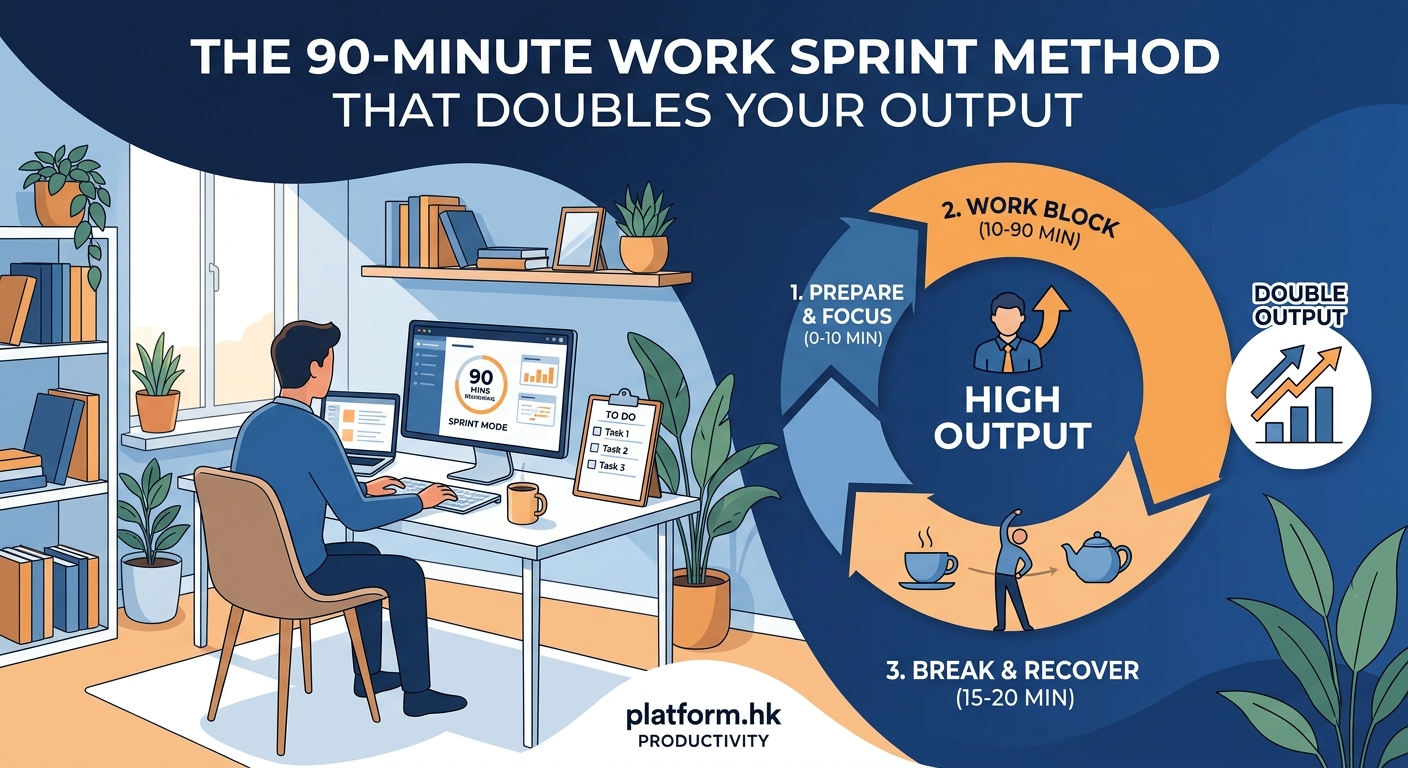
A proper sprint needs structure. Winging it means you’ll bail the moment something more interesting pops up.
Here’s how to set yourself up for success:
-
Pick one outcome. Not a vague goal like “work on proposal.” A concrete deliverable like “finish the budget section of the client proposal.” You should know exactly what done looks like before you start.
-
Clear every distraction. Phone in another room, not face down on your desk. Close your email client completely. Quit Slack. If people can reach you, they will. Your sprint dies the moment you respond to “got a sec?”
-
Set a visible timer. Use your phone timer if it’s in another room, or a kitchen timer, or a browser tab. Knowing the clock is running creates useful pressure. You’re racing yourself.
-
Start with your hardest work. Your first sprint of the day has the most horsepower. Don’t waste it on email or easy tasks. Go straight for the thing you’ve been avoiding.
The first 15 minutes will feel uncomfortable. Your brain will generate seventeen reasons why you should check something first. Push through. That resistance fades around the 20 minute mark.
What happens during the sprint
You’re not just sitting there grinding for 90 minutes. The sprint has a natural arc.
Minutes 0 to 15: The warm-up
Your brain resists. You’ll think of things you forgot to do. You’ll want to look something up that feels urgent. You might feel physically restless.
This is normal. Your mind is testing whether you’re serious. Keep working. The urge to escape will pass.
Minutes 15 to 70: The flow zone
This is where the magic happens. Your thinking gets clearer. Solutions appear. You stop noticing time passing.
You’re in a state that researchers call flow. Your prefrontal cortex quiets down. The part of your brain that worries and plans and second-guesses takes a break.
Work that felt hard 20 minutes ago now feels almost easy.
Minutes 70 to 90: The fade
Your focus starts to slip. You’ll notice yourself rereading the same sentence. Your eyes might feel tired. You start thinking about what’s next.
Don’t fight this. You’re hitting the end of your ultradian cycle. Your body is telling you it needs a break.
Finish your current thought and stop. Trying to push past 90 minutes gives you diminishing returns. You’ll spend 30 minutes accomplishing what you could have done in 10 minutes fresh.
The recovery period matters as much as the sprint
Most productivity advice tells you to take a five-minute break. Walk around your desk. Grab some water. Then get back to it.
That’s not a real break. Your brain needs actual recovery.
After a 90 minute sprint, take at least 15 to 20 minutes completely away from focused work. Longer is better.
Your ultradian rhythm includes a natural rest phase. Skipping it means your next sprint will be weaker.
Good recovery activities:
- Walk outside without your phone
- Eat something
- Do a household chore that requires zero thinking
- Lie down and close your eyes
- Have an actual conversation with someone
Bad recovery activities:
- Scroll social media
- Check email
- Read articles
- Watch YouTube
- Do “light work”
Your brain doesn’t recover when you feed it more information. It recovers when you give it nothing to process.
How many sprints can you actually do?
Three to four high-quality sprints per day is the realistic maximum for most people.
Elite performers top out around four to five hours of intense focused work per day. That’s it. The rest of the time goes to meetings, communication, planning, and recovery.
If you’re new to sprint work, start with one per day. Just one. Build the habit before you try to scale it.
A single 90 minute sprint where you actually focus will produce more valuable work than an entire day of distracted half-attention.
Most knowledge workers spend their days in what author Cal Newport calls “shallow work.” Email, meetings, Slack messages, minor tasks. Stuff that feels like work but doesn’t move anything forward.
One sprint of deep work beats eight hours of shallow work every time.
Common mistakes that kill your sprint
| Mistake | Why it fails | Better approach |
|---|---|---|
| Starting without a clear outcome | You waste 20 minutes figuring out what to do | Define your deliverable before the timer starts |
| Keeping your phone nearby | You’ll check it. You know you will. | Different room, or give it to someone else |
| Picking tasks that are too big | You won’t finish, you’ll feel defeated | Break big projects into 90-minute chunks |
| Skipping the recovery break | Your next sprint will be 50% less effective | Treat recovery as part of the method, not optional |
| Sprinting on low-priority work | You’ll finish feeling busy but not accomplished | Always sprint on high-impact tasks first |
| Working past 90 minutes | Diminishing returns kick in hard | Stop when the timer goes off, even mid-sentence |
The biggest mistake is trying to sprint when you’re already mentally depleted. If you’ve spent two hours in meetings and answered 40 emails, you don’t have a 90 minute sprint in you.
Schedule your sprints for when you’re fresh. For most people, that’s first thing in the morning.
Adapting sprints to your actual schedule
The ideal version has you doing a sprint, taking a break, doing another sprint. Reality doesn’t always cooperate.
You have meetings. Calls you can’t reschedule. A coworker who needs an answer.
That’s fine. The method still works.
If you only have one open block: Do one sprint on your highest-priority task. One focused 90 minutes beats nothing.
If your morning is packed: Schedule your sprint for early afternoon. You’ll be fighting a post-lunch energy dip, but a structured sprint helps you push through it.
If you get interrupted mid-sprint: Don’t try to restart where you left off. The flow state is broken. Either handle the interruption and start a fresh sprint later, or protect your sprint time better tomorrow.
If 90 minutes feels too long: Start with 45 or 60 minutes. Build your focus stamina over weeks. Some focus is better than no focus.
The method is a framework, not a prison. Adapt it to your constraints while keeping the core principle: uninterrupted focus on one meaningful outcome.
What to sprint on
Not every task deserves a sprint. Email doesn’t need 90 minutes of focused attention. Neither does expense reports or calendar management.
Sprint on work that requires thinking:
- Writing anything that matters (proposals, articles, strategy docs)
- Coding or technical problem-solving
- Design work
- Strategic planning
- Learning new skills or information
- Creative work (video editing, graphic design, content creation)
- Financial modeling or analysis
- Research and synthesis
These are tasks where interruptions destroy your progress. Where you need to hold complex information in your head. Where the quality of your thinking directly impacts the quality of your output.
Save your sprints for work that actually moves your career or business forward.
“The ability to perform deep work is becoming increasingly rare at exactly the same time it is becoming increasingly valuable in our economy. The few who cultivate this skill will thrive.” – Cal Newport
Tracking your sprint effectiveness
You’ll want to know if this actually works for you. Measure it.
After each sprint, jot down three things:
- What you accomplished
- How focused you felt (1 to 10 scale)
- What distracted you or broke your focus
Do this for two weeks. You’ll start seeing patterns.
Maybe you focus better in the morning. Maybe certain types of tasks work better in sprints than others. Maybe you need 20 minute breaks, not 15.
The data tells you how to optimize your personal sprint protocol.
You’ll also build a record of what you’re actually accomplishing. On days when you feel unproductive, you can look back and see that you finished three major deliverables this week.
Feelings lie. Data doesn’t.
Combining sprints with the rest of your work
Your day can’t be all sprints. You have communication, collaboration, and coordination work that matters too.
Structure your day in blocks:
Morning: One to two sprints on your most important work
Midday: Meetings, calls, collaboration, email
Afternoon: One sprint if you have energy, or batch processing of smaller tasks
End of day: Planning tomorrow, clearing your inbox, wrapping loose ends
This structure protects your peak focus hours for work that requires peak focus. Everything else fits around it.
Some days won’t follow this pattern. You’ll have an all-day workshop or back-to-back client calls. That’s fine. Get back to sprint structure the next day.
Consistency over weeks matters more than perfection on any single day.
Making sprints stick as a habit
The first week will feel hard. You’ll be tempted to quit mid-sprint. You’ll rationalize why today is different and you should just multitask.
Push through the first week. By week two, your brain starts to expect the structure. By week three, you’ll feel weird on days when you don’t sprint.
Three things that help sprints become automatic:
-
Same time every day. Your brain loves patterns. First thing after your morning coffee, or right after lunch, or whatever. Consistency builds the habit faster than willpower.
-
Physical ritual. Put on headphones (even without music). Close your door. Move to a different room. The physical action signals to your brain that sprint time is starting.
-
Visible commitment. Tell your team when you’re sprinting. Put it on your calendar. Block the time. Public commitment makes you more likely to follow through.
After a month, sprints stop feeling like a productivity technique. They just become how you work.
Your brain already knows how to do this
You’ve experienced this kind of focus before. Remember cramming for a final exam with a hard deadline? Or finishing a project the night before it was due?
That desperate, focused energy where everything else disappeared and you just worked? That’s the state you’re creating on purpose with a sprint.
The difference is you’re not waiting for panic to force you into focus. You’re choosing it deliberately.
Your brain is capable of incredible focus. You just need to give it the right conditions: a clear target, no escape routes, and a time limit.
The 90 minute focus sprint isn’t about working harder. It’s about working in a way that matches how your brain actually functions.
Start with one sprint tomorrow. Pick your most important task. Set a timer. Turn off everything that beeps.
Ninety minutes from now, you’ll have made more real progress than you usually make in a full day of distracted work.