Should Your Business Invest in a Private Office or Coworking Membership?
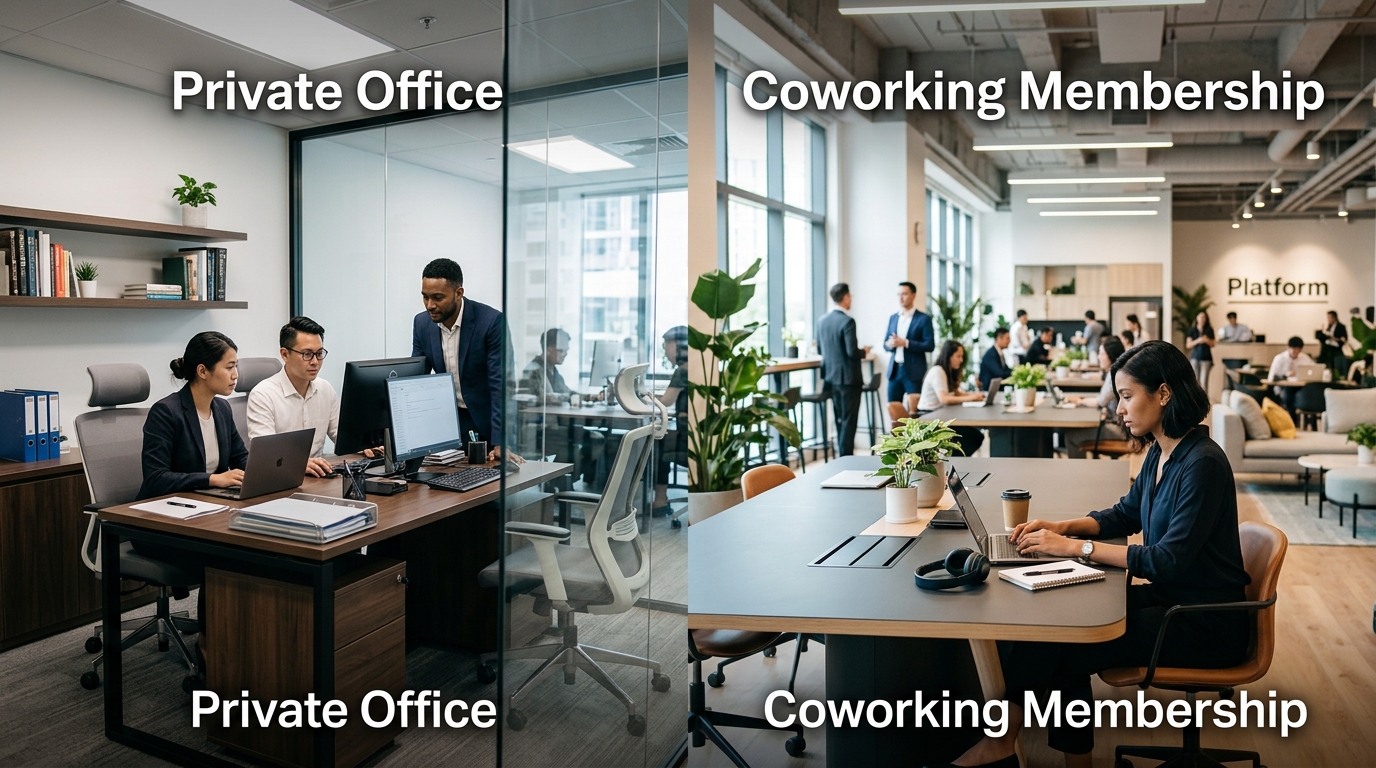
Your team has outgrown the coffee shop corner table. You need real workspace, but the options feel overwhelming. Private offices promise control and professionalism. Coworking spaces offer flexibility and community. Both sound great on paper, but your budget and business model will only support one choice right now.
Private offices provide dedicated space, privacy, and brand control but require longer commitments and higher costs. [Coworking memberships](https://en.wikipedia.org/wiki/Coworking) offer flexibility, networking opportunities, and lower entry points but sacrifice privacy and customization. Your choice depends on team size, growth trajectory, budget constraints, and whether you value stability over adaptability. Most businesses benefit from starting with coworking, then transitioning to private offices as needs solidify.
Understanding the core differences
Private offices and coworking memberships serve different business needs. A private office gives you a dedicated, enclosed space that only your team accesses. You get your own door, walls, and often the ability to customize the interior. Coworking memberships grant access to shared spaces where multiple companies work alongside each other, typically with open desks, communal areas, and bookable meeting rooms.
The distinction goes beyond physical walls. Private offices operate more like traditional leases with fixed terms, usually 12 to 36 months. You pay for the space whether you use it daily or not. Coworking memberships function more like gym memberships with monthly or even daily options. You pay for access and flexibility rather than exclusive territory.
Your business stage matters here. A three-person startup testing product-market fit has different needs than a 15-person team closing enterprise deals. The workspace that serves you today might constrain you in six months, or you might be paying for empty desks you don’t need yet.
Breaking down the real costs
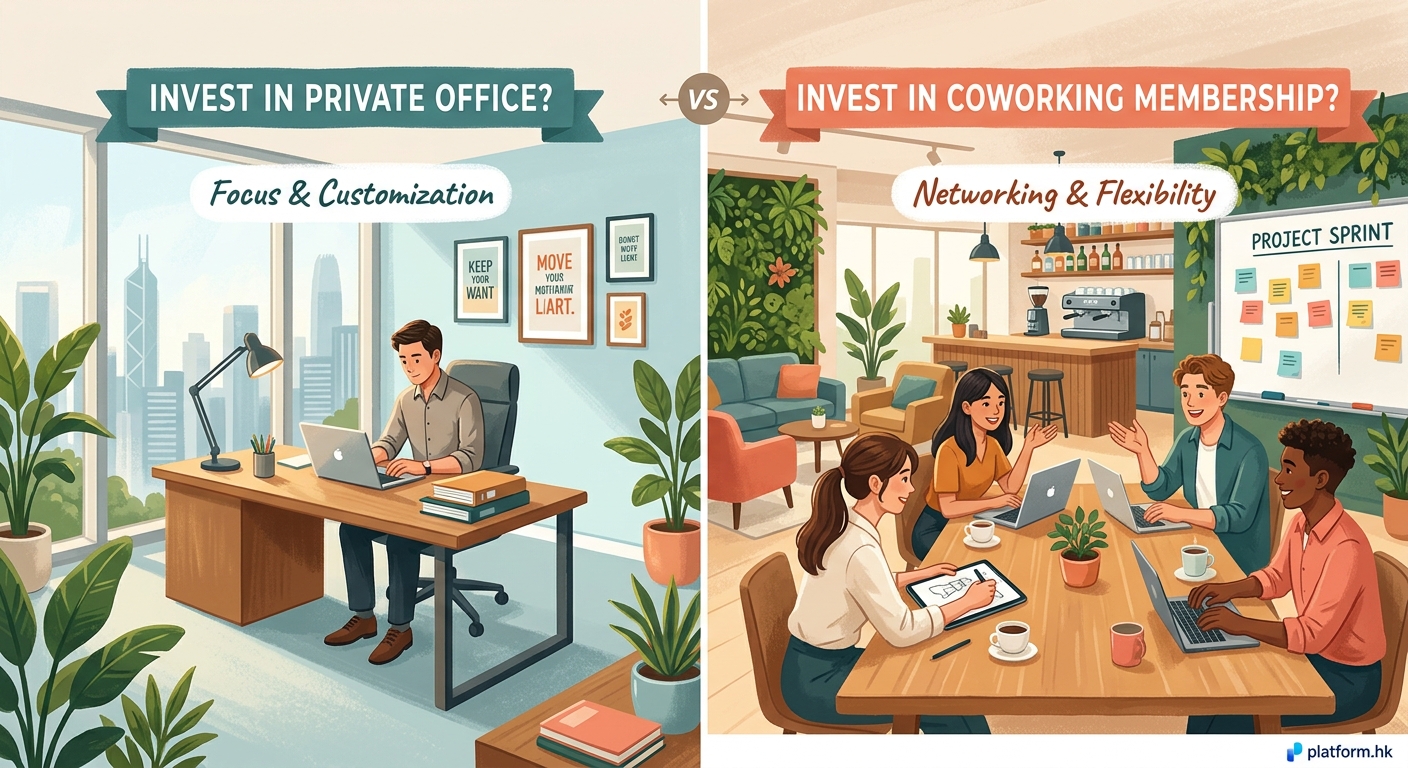
Monthly rates tell only part of the financial story. Private offices in major markets typically range from $500 to $2,000 per person monthly, depending on location and amenities. That rate usually includes basics like furniture, internet, and utilities. But you’ll face upfront costs too: security deposits (often two to three months’ rent), setup fees, and sometimes furniture packages if the space comes unfurnished.
Coworking memberships start lower, often $200 to $600 per person monthly for dedicated desks, or $100 to $300 for hot desks where you grab any available spot. The entry barrier stays minimal. Most providers require just one month upfront with no security deposit. You can scale up or down with a month’s notice instead of being locked into a multi-year commitment.
Hidden costs matter. Private offices often require you to handle your own supplies, coffee, cleaning services, and sometimes even reception coverage. Coworking spaces bundle these amenities into the membership fee. You get coffee, printing credits, cleaning, and front desk services included. That convenience has value when you calculate your true cost per employee.
Here’s how the numbers actually compare:
| Cost Factor | Private Office | Coworking Membership |
|---|---|---|
| Monthly rate per person | $500 – $2,000 | $200 – $600 (dedicated desk) |
| Upfront deposit | 2-3 months rent | 1 month or none |
| Contract length | 12-36 months | Month-to-month or 3-6 months |
| Amenities included | Basic utilities only | Coffee, printing, cleaning, reception |
| Customization ability | High | Minimal to none |
| Scaling flexibility | Low (fixed space) | High (add or remove desks monthly) |
Privacy and focus considerations
Private offices win decisively on privacy. You control who enters your space. Confidential client calls, sensitive financial discussions, and proprietary product development all happen behind closed doors. If your business handles regulated data or client information covered by privacy laws, a private office might not be optional but required.
Coworking spaces vary wildly on noise and distraction levels. Some offer phone booths and quiet zones. Others feel like bustling cafes where concentration becomes a battle. You can book private meeting rooms, but availability isn’t guaranteed during peak hours. That uncertainty creates stress when you have back-to-back client calls or need to record podcast episodes.
Your team’s work style matters. Developers writing complex code often need sustained focus without interruptions. Sales teams making 50 calls daily might thrive in the energetic buzz of a coworking space. Creative teams might find inspiration in the cross-pollination of ideas that happens naturally in shared environments.
The biggest mistake I see is choosing workspace based on what sounds cool rather than what your team actually needs daily. If your business model requires four hours of deep focus work every morning, a lively coworking space will hurt productivity no matter how great the coffee is.
Flexibility and commitment trade-offs
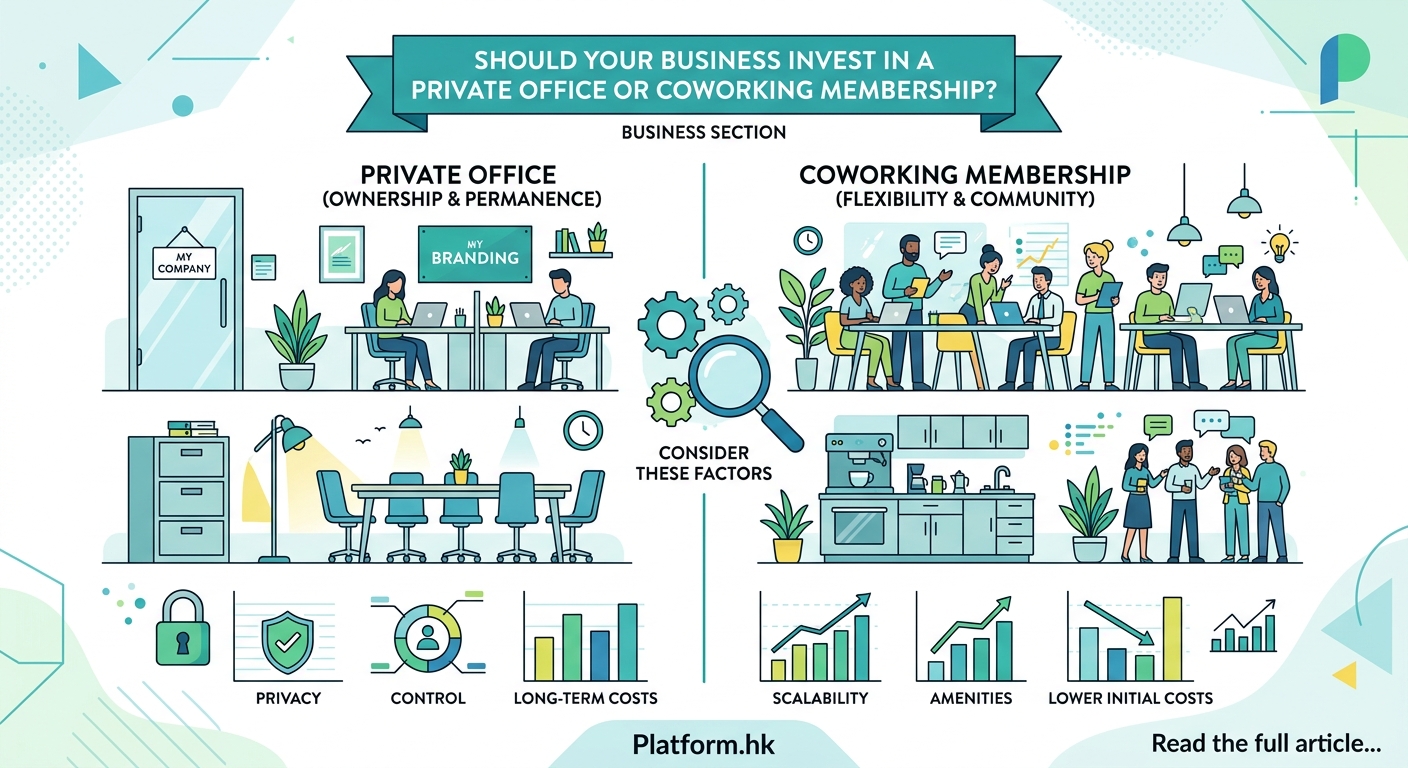
Coworking memberships give you options when your business changes direction. Hired three people faster than expected? Add desks next month. Lost a major client and need to cut costs? Reduce your membership in 30 days. That agility matters enormously for startups and growing businesses where next quarter remains unpredictable.
Private offices lock you in. Breaking a lease early typically means paying penalties or remaining liable for rent until the landlord finds a replacement tenant. If your business grows rapidly, you might outgrow the space but still owe 18 months of rent. If growth stalls, you’re paying for empty desks you can’t afford.
But that commitment brings stability. You’re not competing for meeting rooms or wondering if your favorite desk will be available. Your team develops routines. Clients visiting your office see consistent branding and professionalism. You can leave equipment, whiteboards, and supplies without packing up nightly.
Brand and culture implications
Your workspace communicates messages about your business. A private office with your logo on the door, your color scheme on the walls, and your choice of furniture tells clients you’re established and serious. You control every detail of the environment your team and visitors experience.
Coworking spaces limit brand expression. You might get a small locker or desk nameplate, but you’re working in someone else’s aesthetic. For some businesses, that’s fine. For others, especially those in creative industries or serving high-end clients, the generic coworking look undermines positioning.
Team culture develops differently in each environment. Private offices create clear boundaries between your company and others. Your team develops inside jokes, routines, and identity separate from the outside world. Coworking spaces blur those boundaries. Your team interacts with other companies daily, which can spark innovation but also creates distraction and potential talent poaching.
Networking and community factors
Coworking spaces sell community as a core benefit. You’ll meet founders, freelancers, and professionals from different industries. Those connections can lead to partnerships, referrals, and new perspectives on your business challenges. Many coworking providers host events, workshops, and social gatherings designed to facilitate networking.
The value of coworking community depends entirely on your business model and personality. If you’re building a B2B SaaS product and the space hosts mostly designers and writers, the networking value drops. If you’re an introvert who finds small talk draining, the constant social pressure of coworking spaces becomes exhausting rather than energizing.
Private offices isolate you more. You won’t accidentally meet potential collaborators in the kitchen or learn about industry trends during lunch conversations. But isolation can be productive. Your team focuses on internal goals without external distraction. You build deeper relationships within your company rather than spreading attention across a broader but shallower network.
Making the decision for your business
Start by answering these questions honestly:
- How predictable is your headcount over the next 12 months?
- Does your work require regular confidential conversations or handling sensitive data?
- Can your business model afford the higher upfront costs and longer commitment of a private office?
- Will your team use the networking opportunities in a coworking space, or will they find them distracting?
- Do you need to customize your space for branding, equipment, or specific workflows?
- How important is it that clients can visit a professional, branded office environment?
Your answers reveal patterns. If you checked yes for questions 2, 5, and 6, and your budget supports it, a private office likely serves you better. If questions 1, 3, and 4 make you hesitate, coworking gives you the flexibility to figure things out without overcommitting.
Most businesses aren’t purely one or the other. You might start with coworking to test the market and validate your business model. Once you’ve proven the concept and your team reaches eight to ten people, the economics shift. At that size, the cost per person in a private office often becomes competitive with coworking, and the benefits of privacy and customization outweigh the flexibility advantage.
Common mistakes to avoid
Business owners consistently make these errors when choosing workspace:
-
Overestimating growth: Signing a lease for 20 desks when you have five people because you’re certain you’ll hire 15 more this year. Growth rarely follows the hockey stick curve you projected.
-
Undervaluing amenities: Choosing the cheapest option without calculating the time and money spent managing supplies, coordinating cleaning, or fixing internet issues that coworking spaces handle automatically.
-
Ignoring location impact: Selecting workspace based solely on cost without considering commute times for your team or accessibility for clients. A cheap office an hour outside the city costs you in recruitment and meeting efficiency.
-
Dismissing culture fit: Touring spaces during quiet morning hours, then discovering the afternoon environment is chaotic and loud. Visit during peak times when you’ll actually work there.
-
Skipping the trial period: Many coworking spaces offer day passes or week-long trials. Use them. Work a full week there before committing to see how the reality matches the marketing photos.
Hybrid approaches worth considering
You’re not limited to pure private office or pure coworking. Several middle paths exist:
A private office within a coworking space gives you a dedicated room with a door while maintaining access to communal amenities and networking. You get privacy for focused work and confidential calls, plus the option to use shared spaces for casual collaboration. Costs typically fall between dedicated desks and standalone private offices.
Some businesses maintain a small private office for core team members and leadership while purchasing coworking day passes for remote employees or contractors who need occasional workspace. This approach optimizes costs while providing flexibility.
Others start with coworking memberships but book private meeting rooms daily as needed. You maintain the flexibility and lower costs of coworking while ensuring privacy for client meetings and sensitive discussions. This works well for small teams that spend most time on independent work but need professional meeting space regularly.
When to transition from one to the other
Growth triggers exist that signal it’s time to switch. Moving from coworking to a private office makes sense when:
- Your team consistently struggles to book meeting rooms during business hours
- You’re handling regulated data that requires physical security controls
- Clients visiting your workspace comment on the shared nature or noise level
- Your monthly coworking costs for 8-10 people approach what a small private office would cost
- Team members report difficulty focusing due to coworking space distractions
Moving from a private office to coworking happens less often but makes sense when:
- Your lease ends and your business model has shifted toward remote work
- You’ve downsized and the private office feels empty and expensive
- Cash flow constraints require immediate cost reduction
- You’re pivoting and need flexibility while testing new directions
Getting workspace right for your stage
Your first office choice isn’t permanent. Business needs change. The workspace serving you perfectly today might constrain you tomorrow. That’s normal.
Start with the option that matches your current reality, not your aspirational future. If you’re pre-revenue with three founders, coworking gives you professional space without betting the farm on rent. If you’re 15 people with predictable revenue and handling client data, a private office provides the stability and security you need.
Test before you commit. Tour multiple spaces. Work from them for a day. Talk to current tenants about their experience. The decision matters because your team will spend 40-plus hours weekly in this environment. Choose the workspace that removes obstacles rather than creating them, and don’t be afraid to switch when your needs evolve.