How Startup Teams Structure Weekly Meetings Across Coworking Locations
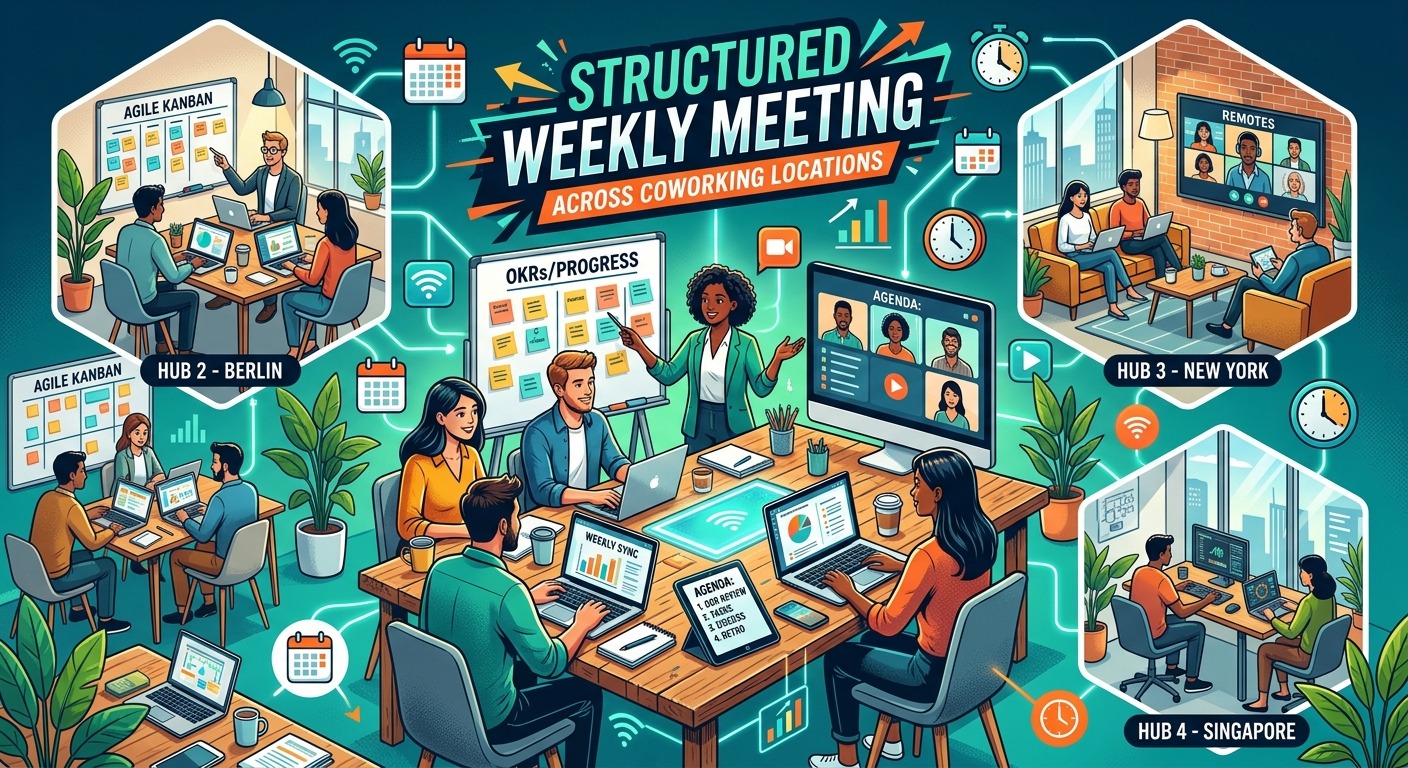
Your lead developer is at a coworking space across town. Your designer grabbed a hot desk in a different building. You are dialing in from a phone booth in a third location. And by Friday, a product decision still needs to get made. That is the operational reality for a growing number of startup teams built around coworking memberships instead of long leases. The flexibility is real. But without deliberate structure, the meetings holding your team together start to quietly break down, week by week.
Team Meeting Snapshot
Startup teams using coworking spaces as their primary venue face a specific coordination challenge: rotating desks, no fixed boardroom culture, and decisions that vanish into chat threads. This guide covers how to set a standup cadence, apply an async-first filter before booking calls, build agenda discipline across distributed members, and use the right tools to make sure every meeting produces a traceable output worth acting on.
Why Coworking Spaces Create a Distinct Meeting Problem
Fixed offices build meeting culture almost by accident. Proximity does a lot of the work. Someone catches you in the kitchen. You grab a whiteboard for five minutes before lunch. Decisions happen in passing. In a coworking setup, proximity is inconsistent. Not everyone is in the same building on the same day. The phone booth you used last Thursday is now booked. The open lounge is too loud for a serious call.
These are not dealbreakers. They are conditions to design around. The practical response is treating every meeting as a scheduled, intentional event rather than something that just happens when people happen to be nearby. That shift changes how your team allocates meeting time. It gets planned for, prepared for, and followed up on. Without that shift, coworking flexibility creates a version of meeting chaos that erodes alignment faster than most founders expect.
Applying an Async-First Filter Before Booking Any Call
Before any meeting appears on the calendar, it should pass one basic test: can this be handled without a live call? If the answer is yes, it belongs in an async format. Status updates, context-sharing, announcements, and written feedback are almost always better handled outside a meeting. Loom videos, shared documents, and structured notes accomplish all of that without pulling four people into a call for 30 minutes.
Real-time meetings earn their place when the work genuinely requires it. Live debate, judgment calls that benefit from group input, collaborative problem-solving, and relationship investment all justify a calendar slot. A useful working rule for distributed coworking teams is this: if fewer than two people need to actually speak, it is probably async. If it involves real disagreement or a live decision, it belongs on the calendar.
Applying this filter consistently cuts a significant share of weekly meeting volume. Research on workplace behavior consistently shows that a large portion of meetings could be replaced with a well-structured written update. For a team already managing the friction of multiple coworking locations, protecting that saved time is not just efficient. It makes the meetings that remain worth attending.
Standup Cadence That Holds Up Across Rotating Desks
Keeping the Format Consistent Regardless of Location
The daily standup has a long history in software teams, rooted in what became a widely adopted agile coordination practice. Startup teams across industries borrowed the format because the core logic is sound. But the coworking context adds variables that standard standup guidance does not account for.
The most important structural decision is picking a fixed time and protecting it. Fifteen minutes at the same time each morning creates a rhythm team members can plan around, regardless of which building they are working from that day. A flexible standup window that shifts by location or convenience tends to shrink in value until it disappears from the calendar entirely.
Keep the format to three questions: what did you finish yesterday, what are you doing today, and what is blocking you. Anything outside those three questions moves to a separate conversation after the standup ends. The standup is a coordination checkpoint. Treating it as a problem-solving session turns a tight daily habit into a meeting people start finding reasons to miss.
For teams spanning more than one city, an async text standup often works better than a video call. Each person posts their three answers within a set morning window. Everyone reads them on their own schedule. The coordination value is preserved without requiring simultaneous availability across time zones.
Agenda Discipline When Your Team Sits in Different Places
What Every Agenda Item Needs Before the Meeting Starts
An agenda is not a formality for distributed teams. It is a coordination document that tells people what to prepare, how long to protect on their calendar, and what the meeting is supposed to actually decide. Without it, coworking meetings drift, particularly when half the team is dialing in from a noisy shared lounge and cannot easily pause to ask for clarification.
Three habits build strong agenda discipline over time. The first is writing the agenda before inviting people. A calendar invite with no agenda is a placeholder, not a meeting. The second is including a desired outcome for each item rather than a topic label. “Discuss pricing” is vague. “Decide on three pricing tiers before the end of the call” gives everyone a target. The third is circulating the agenda at least 24 hours in advance, especially for members traveling between coworking sites who may need to pull together materials before arriving.
Assigning agenda ownership helps considerably. The person who added an item leads that section, arrives prepared, and is responsible for keeping their segment on time. This distributes the facilitation load and prevents one or two voices from driving every meeting from start to finish.
Keeping Decisions Traceable Across Locations and Weeks
This is where most distributed startup teams quietly fall apart. A decision gets made on a Friday video call. Some members were in a busy coworking lounge and caught only part of it. Notes ended up in someone’s personal notebook or a private document that nobody else has access to. Two weeks later, nobody agrees on what was decided, and the same conversation starts again from scratch.
The structural fix is a dedicated layer where agendas live before meetings and decisions are captured immediately after. A startup meeting tool built for this specific gap connects calendar events with living agenda documents, lets team members add items before the call begins, and records action items so they do not vanish into a chat log once the call ends. For a team distributed across multiple coworking buildings or cities, that kind of structured layer becomes the consistent backbone that physical proximity once provided for free.
The behavioral rule to pair with any tool is simple: no meeting ends without a recorded decision or a named next action. If a call produced nothing traceable, it either did not need to happen, or it did not run well enough to generate output. Holding to that standard consistently separates teams that get faster over time from those that keep covering the same ground each week.
Five Practical Habits That Keep Coworking Meetings Focused
Starting every week with a short planning sync sets shared direction before the week fragments across different desks and buildings. This is not a status update meeting. It covers the week’s priorities, any decisions that need to be made before Friday, and any context team members need to work independently without constant check-ins. Twenty to thirty minutes on Monday morning is almost always worth it.
Rotating the meeting facilitator role keeps every team member engaged and spreads the skill of running a productive meeting. In a coworking context, the person who booked the room is not automatically the right person to lead it. A rotating schedule builds meeting fluency across the whole team and prevents one-person bottlenecks in agenda leadership.
Using a “parking lot” for off-topic items protects the agenda from expansion in real time. When an interesting tangent comes up during a meeting, write it down in a shared space and return to it afterward. Letting every thread run its course in real time is how a 15-minute standup grows into a 45-minute call with no clear output.
Protecting buffer time around meetings matters more in coworking contexts than in private offices. Moving from a hot desk to a phone booth to a video room takes real time. Building ten to fifteen minutes before and after each meeting into the calendar prevents the meeting itself from starting rushed and ending abruptly before anything gets documented.
Closing each week with a short written recap replaces the “I thought we agreed on that” conversations the following Monday. One person, on a rotating schedule, writes up what was decided, what is still pending, and what moved forward. It takes five minutes to produce and saves considerably more than that in repeated clarification over the days that follow.
What Scattered Meetings Are Really Costing Founders Who Are Not Counting
Startup founders track overhead carefully. Coworking memberships, software subscriptions, contractor invoices; every cost has a justification. Meeting inefficiency almost never appears in a spreadsheet, even though for most lean teams it is one of the larger invisible costs in the business.
A team of six where two hours per week are lost to unclear or unnecessary meetings is losing twelve person-hours weekly. At a modest fully-loaded hourly cost per person, that adds up to tens of thousands of dollars annually in time that produced nothing. That figure does not include the downstream cost of slow decisions, repeated conversations caused by undocumented outputs, or the trust erosion that builds when team members sense that their meeting time is not being respected.
Coworking spaces are a genuine strategic advantage for startups watching their burn rate. They offer flexibility, infrastructure, and community without long-term commitments. But that advantage only compounds when the team using those spaces can coordinate effectively across them. The standup cadence, the async filter, the agenda habit, and the tool that captures decisions are not administrative overhead. They are the operating layer that makes distributed coworking viable at the speed a startup actually needs to move.