Should Your Startup Go Remote, Hybrid, or Coworking? A Decision Framework
Choosing where your team works is one of the first decisions that will shape your startup’s culture, budget, and ability to hire. The workspace model you pick today will ripple through every aspect of how you build your company.
Startup founders must weigh three workspace models: fully remote offers maximum cost savings and global talent access, hybrid balances flexibility with in-person collaboration, and dedicated offices build the strongest culture but carry the highest fixed costs. Your choice depends on your team size, funding runway, collaboration needs, and hiring strategy. Most early-stage startups benefit from starting remote or hybrid, then scaling into office space as headcount and revenue grow.
Why Your Workspace Choice Matters More Than You Think
The workspace decision affects your burn rate, talent pool, collaboration quality, and company culture all at once.
Pick wrong and you’ll watch your runway shrink faster than expected. Or struggle to build the team chemistry that turns a group of contractors into a unified company.
Each model comes with tradeoffs. Remote work slashes costs but makes spontaneous collaboration harder. Offices create energy and connection but lock you into lease commitments before you’ve found product-market fit. Hybrid sounds perfect on paper but requires deliberate systems to avoid creating two-tier teams.
Let’s break down each option so you can make the right call for your specific situation.
The Full Remote Model: Maximum Flexibility, Minimum Overhead
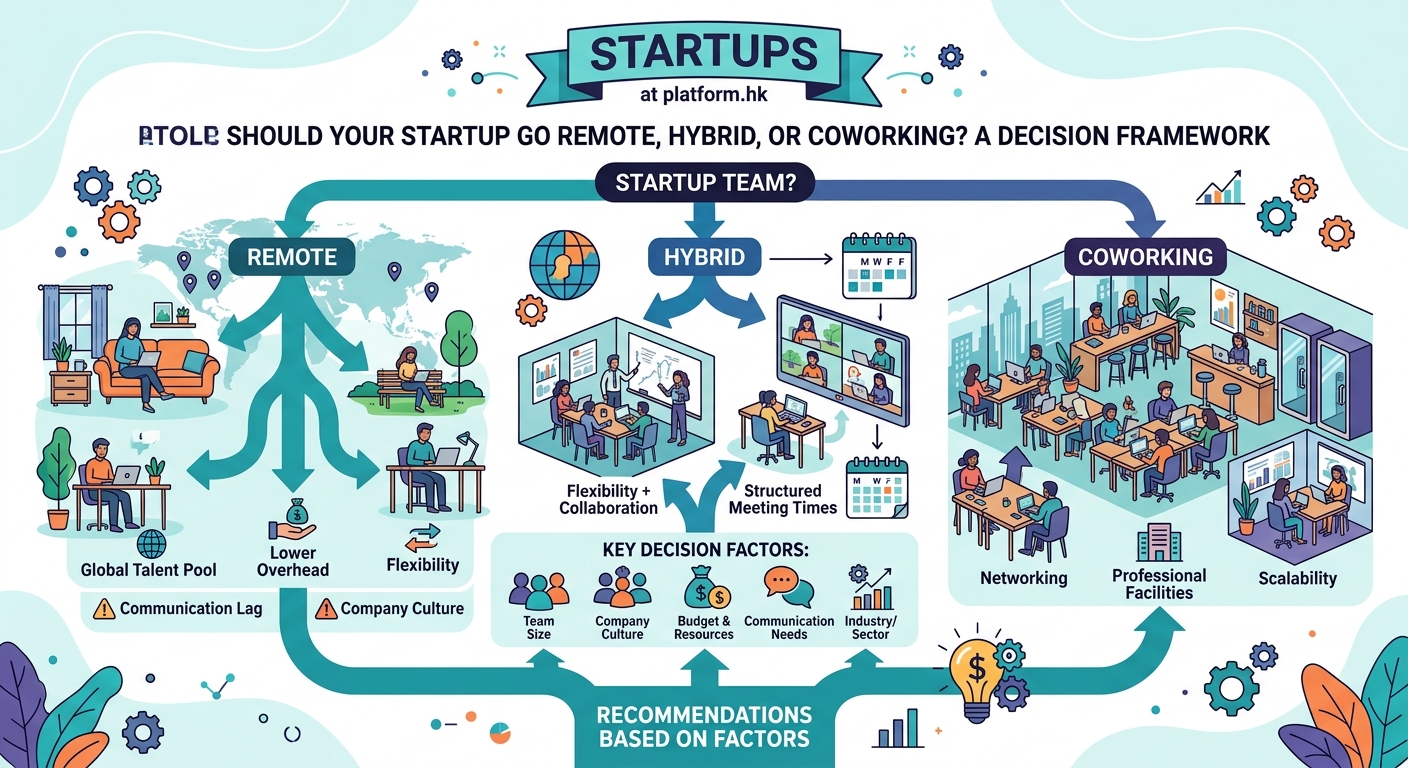
Going fully remote means your team works from wherever they choose. No central office. No required location.
Cost advantages:
Remote work eliminates office rent, utilities, furniture, snacks, and all the hidden costs of physical space. For a 10-person team, you’re saving $5,000 to $15,000 monthly depending on your city. That money goes straight to your runway.
You also skip commute reimbursements and can structure compensation based on employee location rather than headquarters cost of living.
Talent access:
Your hiring pool becomes global. Need a senior Rails developer? You’re not limited to who lives within 30 miles of your office. You can hire the best person regardless of geography.
This matters most for specialized roles where local talent is scarce or prohibitively expensive.
Collaboration challenges:
Async communication becomes your default. Slack messages replace hallway conversations. Video calls substitute for whiteboard sessions.
Some teams thrive in this environment. Others find that the lack of physical presence slows down decision-making and weakens interpersonal bonds.
Time zones add complexity once you span more than three hours of difference. Scheduling meetings becomes a puzzle. Real-time collaboration windows shrink.
Culture building:
Creating shared identity without shared space requires intentional effort.
You’ll need structured virtual rituals: daily standups, weekly all-hands, monthly virtual social events. Some remote-first companies do quarterly in-person retreats to build relationships that carry through the rest of the year.
New hires take longer to feel integrated. Onboarding requires detailed documentation and scheduled check-ins rather than organic learning through observation.
The Dedicated Office Model: Proximity Powers Progress
A dedicated office means your team comes to the same physical location most or all workdays.
Collaboration benefits:
Physical proximity accelerates communication. You overhear relevant conversations. You sketch ideas on whiteboards. You grab someone for a five-minute discussion that would take 30 minutes over Slack.
For product teams iterating rapidly, this speed advantage compounds. Designers, engineers, and product managers can huddle around a screen and make decisions in real time.
Culture creation:
Offices make culture tangible. Your team eats lunch together. Celebrates wins together. Sees each other struggle and succeed.
New employees absorb company norms through observation. They watch how senior people handle challenges, how meetings run, what behaviors get rewarded.
This immersion builds cohesion faster than any number of video calls.
Cost realities:
Office space in major startup hubs runs $500 to $1,500 per desk monthly. A 10-person team needs roughly 1,500 to 2,000 square feet, putting you at $7,500 to $30,000 monthly before furniture, internet, utilities, and amenities.
Most commercial leases require multi-year commitments. You’re betting your headcount will grow into that space and your funding will cover the fixed costs.
Hiring constraints:
Your talent pool shrinks to people who live nearby or are willing to relocate. In expensive cities, this means competing with well-funded companies for the same local talent.
Relocation packages add $10,000 to $30,000 per hire for moving costs, temporary housing, and signing bonuses to offset the life disruption.
The Hybrid Approach: Splitting the Difference
Hybrid models combine remote flexibility with periodic in-person work. The specifics vary wildly.
Some companies require everyone in-office two or three days weekly. Others maintain optional office space for those who want it. Still others operate fully remote but gather quarterly for week-long sprints.
Flexibility advantages:
Hybrid gives employees choice. Parents can avoid commutes on busy days. Deep work happens at home. Collaborative sessions happen in person.
You can hire from a wider geographic area while maintaining some physical presence. Anyone within a two-hour commute becomes viable if they only come in twice weekly.
Coordination complexity:
Hybrid only works if you’re deliberate about what happens where.
You need clear guidelines: which days are in-office, which meetings require physical presence, how remote team members participate when others are co-located.
Without structure, you create inequality. The office crew builds stronger relationships and gets more face time with leadership. Remote workers feel like second-class citizens.
Space efficiency:
Hybrid lets you use smaller, cheaper office space. If half your team is remote and the other half comes in on alternating days, you need fewer desks than headcount.
Coworking memberships work well here. Pay per desk actually used rather than maintaining empty space on remote days.
Decision Framework: Match Model to Your Situation
Your optimal choice depends on specific factors about your startup right now.
| Factor | Remote Works Best | Hybrid Works Best | Office Works Best |
|---|---|---|---|
| Team size | Under 10 people | 10 to 50 people | Over 50 people |
| Funding stage | Pre-seed, bootstrapped | Seed to Series A | Series B and beyond |
| Collaboration needs | Async-friendly work | Mixed sync and async | Constant iteration |
| Geographic distribution | Already spread out | Clustered in 1-2 cities | Single metro area |
| Hiring priority | Specialized, global talent | Balance of local and remote | Local ecosystem relationships |
| Runway sensitivity | Every dollar counts | Moderate budget pressure | Growth over efficiency |
Use this step-by-step process:
-
Calculate your monthly cost difference between models. Include rent, utilities, furniture, commute benefits, and salary adjustments based on location flexibility.
-
Assess your collaboration intensity. Do you ship features independently or need constant cross-functional coordination? Product teams building tightly integrated experiences benefit more from offices than teams building modular components.
-
Evaluate your current team’s preferences. Survey your existing employees honestly. Forcing people into a model they hate will cost you talent.
-
Project your six-month and 12-month hiring needs. If you plan to double headcount, can you find that talent locally? Will remote hiring open necessary skill sets?
-
Test before committing. Start remote or with flexible coworking, then move to dedicated space once you’ve validated your model and growth trajectory.
“We started fully remote to conserve cash and access global talent. Once we hit 25 people and raised our Series A, we took a small office for optional use. By 50 people, we shifted to hybrid with three mandatory in-office days because our product complexity demanded tighter collaboration. Each transition matched our growth stage.” – Founder of a Series B SaaS company
Common Mistakes That Waste Money and Hurt Culture
Signing long office leases too early:
Locking into a three-year lease when you’re pre-product-market fit burns cash and reduces flexibility. If your team shrinks or you need to relocate, you’re stuck paying for empty space.
Start with month-to-month coworking or short-term subleases until your headcount and location stabilize.
Choosing hybrid without clear policies:
Vague “work from anywhere” policies create confusion and resentment. Some people come in daily while others never show up. Team cohesion fractures.
Define specific in-office days, meeting expectations, and how remote participants stay integrated. Document everything.
Underestimating remote work infrastructure costs:
Going remote isn’t free. You need proper video conferencing tools, project management software, async communication platforms, and home office stipends.
Budget $100 to $300 per employee monthly for tools and equipment. Factor in occasional travel for team gatherings.
Forcing office time without purpose:
Requiring in-office days just to justify office rent destroys morale. People will commute for collaborative work sessions, important meetings, or social connection. They’ll resent commuting to sit on Zoom calls they could take from home.
Make in-person time valuable or make it optional.
Ignoring local employment laws:
Hiring remotely across states or countries triggers tax, benefits, and employment law complexity. Each jurisdiction has different requirements.
Use an employer of record service or consult with legal and tax advisors before hiring in new locations.
Adapting Your Model as You Grow
Your workspace strategy should evolve with your company stage.
Pre-seed to seed (1 to 10 people):
Start remote or use flexible coworking. Conserve cash. Test whether your team can collaborate effectively without physical space.
Gather in person monthly or quarterly if budget allows. Use these sessions for strategic planning, relationship building, and high-bandwidth collaboration.
Series A (10 to 30 people):
Consider hybrid with optional office space. You have more budget but still need flexibility as you figure out your go-to-market and scale hiring.
Coworking spaces with private offices work well here. You get professional space without long-term commitments.
Series B and beyond (30+ people):
Most companies move toward dedicated office space at this stage. Your team is large enough that coordination benefits outweigh cost savings.
You might maintain remote flexibility for certain roles or keep satellite offices in multiple cities rather than requiring full-time presence.
The key is matching your workspace to your current needs, not where you hope to be in three years.
Making Your Choice Work
Whatever model you pick, success depends on execution.
For remote teams, invest in communication tools and create structured touchpoints. Build documentation habits. Over-communicate. Schedule regular video face time.
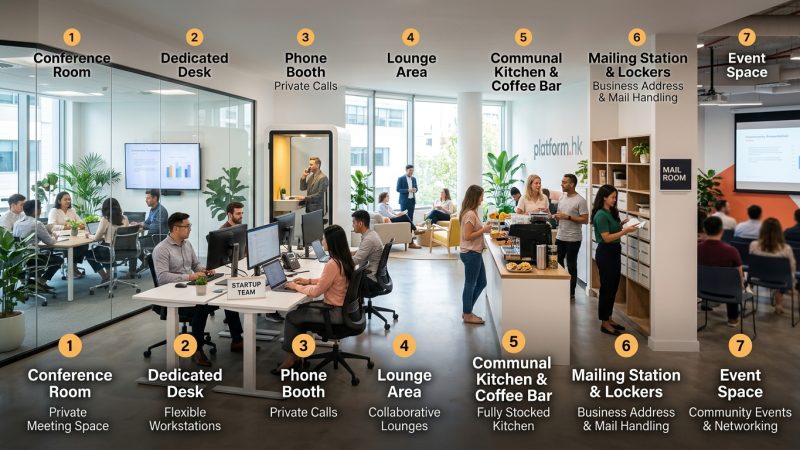
For office teams, design your space for collaboration. Create quiet zones for focused work. Stock good coffee and snacks. Make the commute worthwhile.
For hybrid teams, be ruthlessly clear about when and why people come together. Equip conference rooms properly so remote participants aren’t afterthoughts. Rotate meeting times to accommodate different time zones.
Your workspace model shapes how your team communicates, collaborates, and connects. Choose based on your specific constraints and priorities today, then adapt as your company grows. The best model is the one that lets your team do their best work within your budget reality.