Day Pass vs Monthly Membership: Which Coworking Option Fits Your Lifestyle?

You need a desk, reliable WiFi, and maybe some human interaction that isn’t your cat staring at you during Zoom calls. But should you commit to a monthly coworking membership or stick with day passes?
The answer isn’t the same for everyone. Your work rhythm, budget, and how often you actually need to escape your apartment all play a role in which option makes sense.
Day passes work best for occasional workspace users who need flexibility and visit fewer than eight days monthly, typically costing $25 to $45 per visit. Monthly memberships suit regular users with predictable schedules, offering better value at $200 to $400 monthly plus perks like meeting room credits, mail handling, and community access. Calculate your monthly usage, factor in amenities you’ll actually use, and test both options before committing long term.
What you actually get with each option
Day passes give you access for a single session. You show up, swipe in, grab a desk in the common area, and work until you leave. Most spaces charge between $25 and $45 per day depending on location and amenities.
You get the basics: a desk or table, WiFi, coffee, and sometimes printing credits. Some spaces throw in a few hours of meeting room access if you ask nicely. But you’re essentially renting a chair for the day.
Monthly memberships come in different tiers. The basic tier usually gets you a dedicated desk or guaranteed hot desk access during business hours. Mid-tier plans add meeting room hours, mail handling, and after-hours access. Premium tiers often include private offices or reserved desks.
The price range is wide. Expect $200 to $400 for basic plans in most cities, though premium options in major metros can hit $600 or more.
Here’s what separates the two beyond just pricing:
| Feature | Day Pass | Monthly Membership |
|---|---|---|
| Cost predictability | Varies with usage | Fixed monthly expense |
| Desk consistency | Different spot daily | Same desk or priority access |
| Community integration | Limited | Full member events and Slack channels |
| Meeting room access | Pay per use or none | Included hours monthly |
| Mail and package handling | Usually not available | Included in most plans |
| Cancellation flexibility | No commitment | 30 to 90 day notice typically |
When day passes make more sense
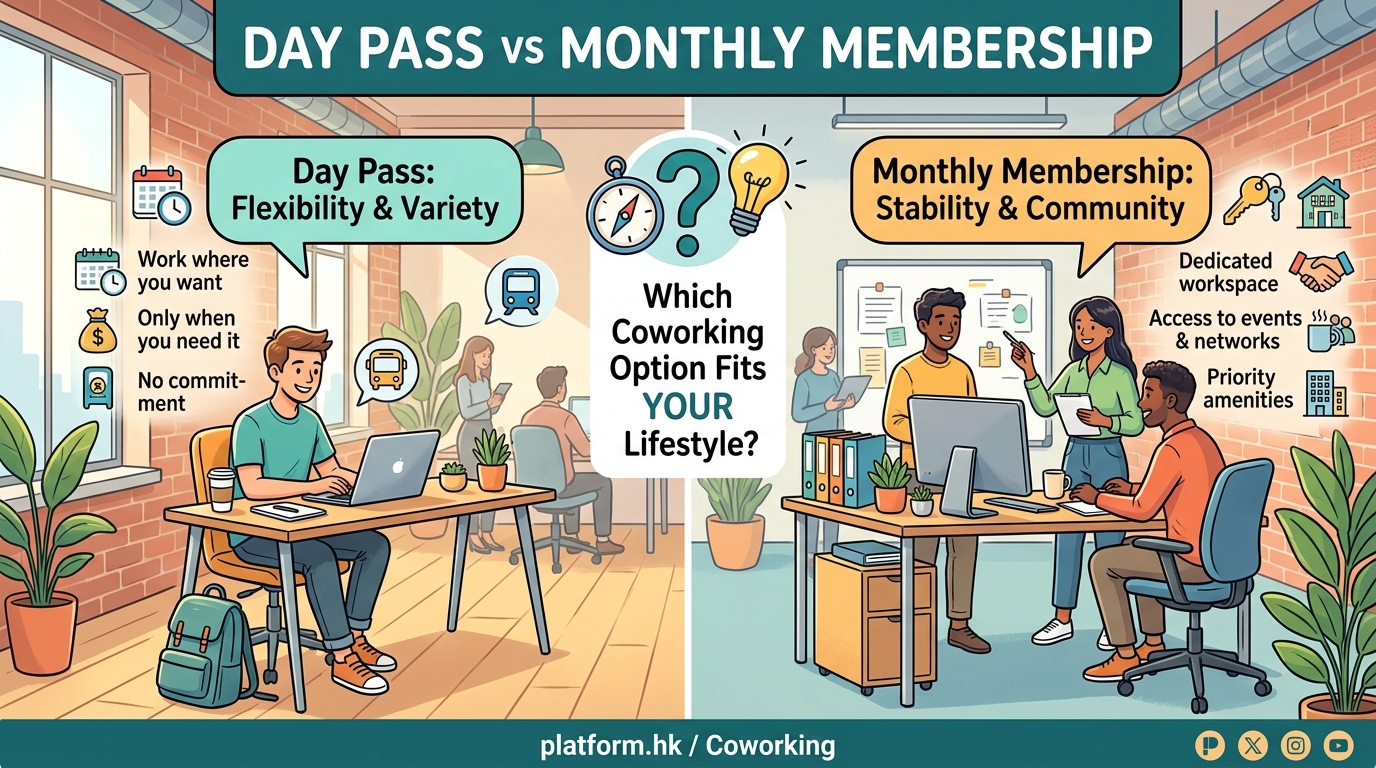
You work from home most days but need an escape hatch. Maybe your internet crashes, your neighbor starts construction, or you just need a change of scenery once a week.
Day passes shine for irregular schedules. If you visit a coworking space fewer than eight days per month, the math usually favors buying passes as needed rather than locking in a membership.
Freelancers with project-based work fit this pattern well. You might have intense client weeks where you need professional meeting space, followed by quiet weeks working from your couch in pajamas.
Digital nomads passing through a city for two weeks benefit from day passes too. You get workspace access without monthly commitment in a place you’ll leave soon anyway.
The flexibility extends to trying different spaces. Buy a day pass at three different coworking spots in your city to test which community and setup you prefer before committing.
Budget variability works in your favor here. Slow income month? Skip the coworking days. Busy season? Buy passes when you need focus time away from home distractions.
Day passes give you permission to be inconsistent with your workspace needs. Some of the best freelance work happens in bursts, not steady routines. Your workspace access should match that reality, not fight it.
When monthly membership pays off
You visit the same space three or more times weekly. At that frequency, day passes become expensive fast.
Do the simple math: If day passes cost $35 and you go 12 times monthly, you’re spending $420. A monthly membership at $300 saves you $120 while adding perks.
But the value goes beyond pure cost comparison. Monthly members get consistency. You can leave books, chargers, or a favorite mug at your desk. You learn the community rhythms and build actual professional relationships instead of being the person nobody remembers.
Meeting room access matters more than you think. Day pass users often pay $25 to $50 per hour for private meeting space. Monthly members typically get 5 to 10 hours included, which covers most client calls and interviews.
Mail handling becomes surprisingly useful. You can use the coworking address for business registration, client correspondence, and package delivery. This matters if you run a registered business or meet clients who expect a professional address beyond your apartment building.
After-hours access changes your schedule options. Need to work at 7 AM or 9 PM? Monthly members can usually access the space outside standard hours, while day passes typically restrict you to 9 to 5 windows.
The community aspect shouldn’t be dismissed as fluff. Regular members get invited to workshops, happy hours, and skill shares. You’re not just renting a desk. You’re joining a network that can lead to collaborations, referrals, and friendships.
How to calculate your break-even point
Start with honest usage tracking. How many days did you actually need workspace outside your home last month? Count them.
Multiply that number by the average day pass cost in your area. Compare it to the monthly membership price.
Your break-even point is usually around 6 to 10 days monthly, depending on local pricing. If you need workspace more than that, membership makes financial sense.
But add these factors to your calculation:
- Meeting room usage: Track how often you need private space for calls. If it’s more than twice monthly, the included hours in a membership save money.
- Commute costs: Factor in transportation. If the coworking space is farther from home than you’d travel casually, fewer visits might make sense even if the per-day math favors membership.
- Amenity value: Do you actually use the printing credits, coffee, or event access? Don’t pay for perks you ignore.
Here’s a practical three-step process to test before committing:
- Buy day passes for one full month and track every visit, noting what amenities you used and whether you felt productive.
- Calculate your total spending and compare it to the monthly membership cost, adding value estimates for meeting rooms or mail service if you needed them.
- Try a month-to-month membership if available, giving yourself permission to cancel if it doesn’t match your actual usage patterns.
The hybrid approach nobody talks about
Some coworking spaces offer punch cards or flex packs. You buy 5 or 10 day passes at a discount, valid for several months.
This middle ground works well for people who need workspace regularly but not predictably. You get better pricing than single day passes without monthly commitment pressure.
Another hybrid option: part-time memberships. Some spaces offer access for specific days (like Monday, Wednesday, Friday only) at 60 to 70 percent of full membership cost.
You can also combine home base membership at one affordable space with occasional day passes at premium locations when you need to impress clients or access specific neighborhoods.
The key is matching your payment structure to your actual work patterns, not aspirational ones. Don’t buy a membership because you think you should work outside your home more. Buy it because you already do and want better value.
Common mistakes that waste money
Buying a membership based on January motivation when you know your summer schedule gets chaotic. Seasonal work patterns matter. If you travel heavily in certain months or have predictable slow periods, day passes might serve you better year-round.
Choosing a space for amenities you never use. That fancy espresso machine and yoga studio sound great, but if you bring your own coffee and skip the classes, you’re subsidizing features for other members.
Ignoring the cancellation terms. Some memberships require 60 or 90 day notice. If your work situation might change, that inflexibility could cost you hundreds in payments for space you’ve stopped using.
Forgetting to negotiate. Many coworking spaces offer discounts for annual prepayment, nonprofit work, or simply asking during slow enrollment periods. The listed price isn’t always final.
Not testing the commute during your actual work hours. A space that’s 20 minutes away at 10 AM might take 45 minutes during morning rush. That changes the value equation significantly.
Here are the red flags that suggest you’ve chosen wrong:
- You have a monthly membership but visit fewer than twice weekly
- You buy day passes at the same space more than 10 times monthly
- You avoid the space because the commute feels too long
- You never use the meeting rooms, events, or community features included in your membership
- You feel guilty about not using your membership enough
Questions to ask before you decide
What’s your actual workspace need? Be specific. “I need reliable WiFi and a desk away from home distractions two days weekly for client calls” is more useful than “I want to be more professional.”
How stable is your income and schedule? Variable income suggests day passes give you flexibility to scale spending with earnings. Stable income makes monthly budgeting easier.
Do you value routine or variety? Some people thrive on the same desk and familiar faces daily. Others get bored and need the option to work from different locations.
What’s your real budget? Not the aspirational number, but what you can consistently afford even during slow months. Workspace access shouldn’t stress your finances.
Are you trying to build local professional networks or just need a desk? Community integration takes time and regular presence. Day pass users rarely become part of the inner circle.
Will you actually use the amenities? Walk through the space and identify which features you’d use weekly versus which sound nice but you’d ignore.
Testing both options without commitment
Most coworking spaces offer free trial days or discounted first-time day passes. Use these to test multiple spaces before choosing where to focus your spending.
Try this experiment: Buy day passes at your top choice for one month. Track your usage, productivity, and whether you missed having consistent desk access or community connection.
If you average more than 8 visits and felt limited by day pass restrictions, try a month-to-month membership the following month. Compare your experience and costs.
The goal isn’t finding the theoretically optimal choice. It’s finding what actually works for your real work habits, not idealized ones.
Pay attention to small details during testing. Does the space feel too quiet or too social for your focus needs? Is the coffee actually drinkable or will you spend extra at the shop next door? Do people chat in common areas or does everyone wear headphones?
These factors affect whether you’ll actually use the space consistently, which determines whether any pricing option delivers value.
Making the choice that fits your life
The coworking day pass versus monthly membership decision comes down to honest self-assessment. How often do you genuinely need workspace outside your home? What amenities actually improve your productivity versus just sounding appealing?
Track your real usage for a month before committing to anything long term. Let your actual behavior guide the decision, not what you think you should do or what works for other freelancers.
The right choice might change as your work evolves. A day pass habit can grow into membership as your client base stabilizes. A membership might shift back to occasional passes if you start traveling more or move to a home office setup you actually enjoy.
Give yourself permission to experiment, adjust, and change your mind as your needs shift. Your workspace strategy should serve your work, not become another source of guilt or wasted money.
